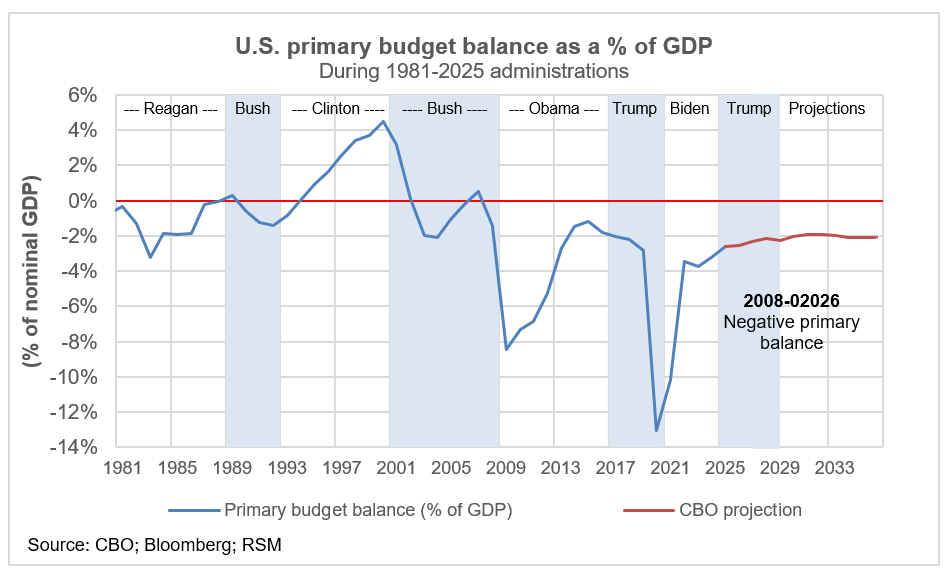
A recent Market Minute highlighted the end of an era of low rates, leading to increased long-term interest rates as investors express concerns about the sustainability of the U.S. fiscal trajectory. With global bond investors now concentrating on inflation and national debt, it becomes crucial to contemplate measures to reduce yields and achieve a more sustainable budget.
Read More
In the current political climate, there is no significant support for fiscal consolidation. Commitments to programs like Social Security and Medicare, along with rising defense spending and economic populism favored by both parties, make a return to balanced budgets—similar to those in the late 1990s—seem unrealistic. To create a sustainable fiscal path, there needs to be a serious effort to bring the primary budget, which excludes interest payments on past debt, back into balance.
As of the end of last year, the U.S. government recorded a primary budget deficit of 2.61% of gross domestic product (GDP), with the Congressional Budget Office projecting this figure to remain at 2.6% over the next decade. However, some experts believe this is overly optimistic, suggesting the deficit may reach between 3% and 3.5% of GDP due to spending commitments from both political parties. The last instance of a balanced primary budget occurred in the final quarter of 2007, just before the onset of the financial crisis. Currently, total government debt exceeds $40 trillion, with interest payments consuming an ever-growing portion of federal expenditures.
To achieve balance in the primary budget, Congress and the executive branch would need to either reduce non-interest spending or raise tax revenues by 2% to 3% of GDP for several years and adhere to that commitment. Without these measures, achieving a balanced budget will remain unattainable.
There is a theory that the U.S. could potentially grow out of its deficit, but experts caution that without a significant increase in productivity—such as through advancements in AI—this scenario is unlikely. Even if the economy manages growth rates of 3.5% to 4% for a decade, while inflation remains high, the numbers still might not add up.
Addressing this issue will require difficult decisions, as seen in Italy during the 2011 European debt crisis. Italy was compelled to implement tax hikes, pension reforms, and significant spending cuts, facilitated by a technocratic government that executed unpopular policies to restore investor confidence.
For the U.S., this could entail raising tax revenues through measures like a value-added tax or reforming Social Security and Medicare, along with critical decisions regarding defense spending. However, this outcome appears improbable given the current political landscape.
There is currently no impending fiscal, banking, or currency crisis pressing American legislators to act, making significant budgetary reform seem unlikely in the near term. Nevertheless, key moments will arise, such as the projected depletion of the Social Security Trust Fund reserves by late 2032 and recurring debt ceiling crises.
It may be prudent to take action now while the economy is growing and almost at full employment to shift the primary budget toward balance, potentially in conjunction with stabilizing Social Security. If not, a fiscal crisis may be the catalyst needed for such necessary reforms.