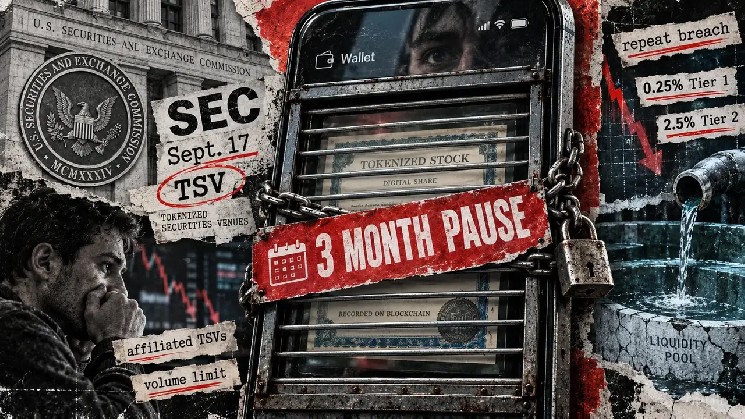
Buying tokenized stocks may seem straightforward, allowing investors to purchase a company's token representing its shares and hold it in a digital wallet. However, new regulations could unexpectedly halt trading for three months, complicating the notion of always-available stocks.
Read More
This potential pause arises from the SEC's September 17 framework for experimental Tokenized Securities Venues (TSVs). A stock may face trading interruptions if it repeatedly breaches a trading volume limit, affecting the stock on the exchange and its affiliates, but not every version of that tokenized stock.
Understanding tokenization involves recognizing the relationship between owning a token, the rights associated with a share, and the ability to sell it. Stocks have already embraced digital formats, with ownership records maintained electronically through brokers. Tokenization introduces blockchain technology to record and transfer ownership claims.
The term “tokenized” refers to the format of the asset, so it's crucial to understand what the token represents. The SEC's January guidelines distinguish between several models of tokenized securities. In one case, a company or its agent utilizes blockchain records for ownership. In another, a third party holds shares and issues tokens representing claims to them. Additionally, synthetic exposure allows financial returns linked to a stock without transferring ownership of shares, which does not automatically confer shareholder rights.
The SEC's new experiment stipulates that qualifying tokenized stocks must maintain the economic and governance rights of traditional stocks, such as dividends and voting, which synthetic exposure does not qualify for. Access to trading is permissioned, requiring participants to meet verification standards.
The SEC has allowed a five-year testing period for trading through automated market makers. This approach uses software to facilitate trades against a pool of assets rather than matching orders between buyers and sellers.
Exchanges participating in this experiment face restrictions on the number of stocks they can offer and the trading volume of each. Volume limits correspond to traditional stock market activity, categorized into two tiers: Tier 1 includes S&P 500 and Russell 1000 stocks, while Tier 2 encompasses other eligible securities. For Tier 1 stocks, the trading volume threshold is set at 0.25% of the prior month's average daily trading volume, and for Tier 2, it is 2.5%.
If a stock breaches its volume limit, the first violation receives a grace period, but subsequent breaches trigger a mandatory three-month trading pause. Trading may halt for that stock across all affiliated TSVs, although other stocks on the exchange can continue trading.
The SEC aims to limit risks to the broader stock market during this experimental phase, particularly the risk of price divergence between the tokenized and traditional stocks. For instance, a limited inventory within the trading pool can lead to price increases for the tokens even if the overall market perception remains unchanged.
Overall, owning and trading tokenized stocks involve different considerations. Buyers should be aware of how to exit their positions, as the trading pause could complicate their plans. Moving tokens to another wallet does not guarantee access to a trading venue for that specific token. Each token's tradability depends on the associated product and supporting institutions.
Longer trading hours also require caution, as extended access does not necessarily ensure a favorable price for selling significant holdings. Prior to purchasing tokenized stocks, buyers should seek clear, detailed scenarios from providers, addressing custody, shareholder rights, permitted transfers, redemption options, and associated costs.
While the SEC's framework may enhance the convenience of trading and ownership, it requires careful consideration of the trading routes before investing. Understanding these mechanisms is essential since having a stock in a digital wallet only provides part of the investment picture.