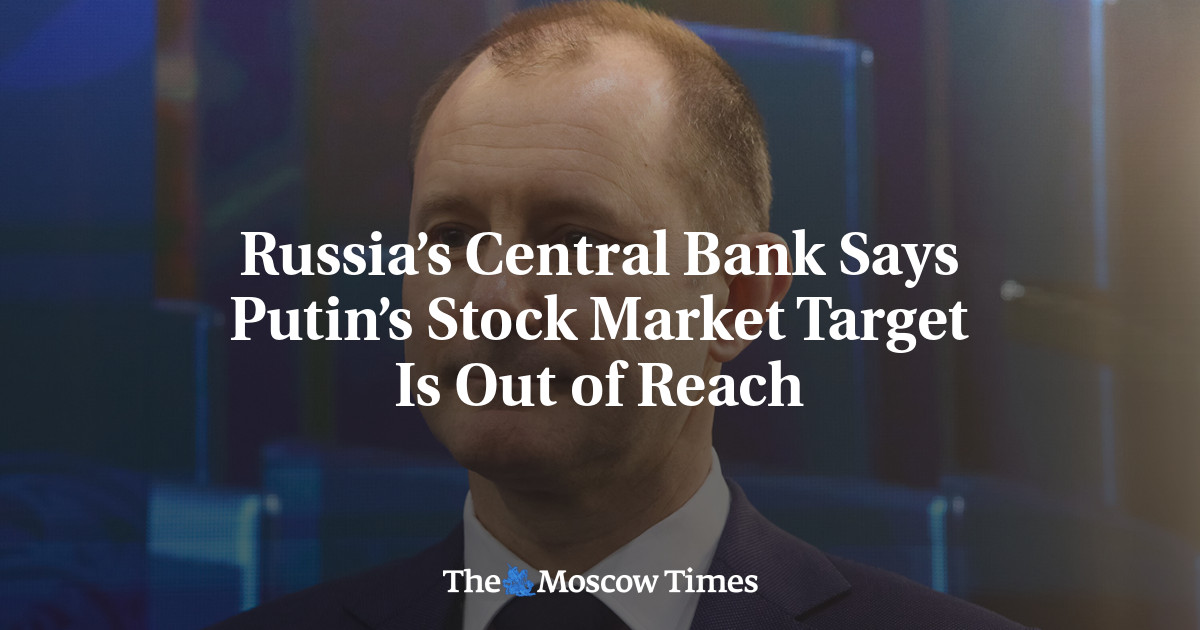
Russia’s Central Bank has expressed skepticism about meeting President Vladimir Putin’s goal for stock market expansion by 2030. A senior official indicated that decreasing share prices and a lack of investor demand hinder progress toward achieving this target.
Read More
First Deputy Governor Vladimir Chistyukhin noted that the Central Bank and Finance Ministry are reevaluating achievable levels of market capitalization, as reported by Interfax. Putin's directive, issued in May 2024, aims to double stock market capitalization to at least 66% of the gross domestic product by 2030, shortly after he began another presidential term.
Chistyukhin stated, “Our calculations simply do not get us to 66%.” This outlook highlights the challenges faced by the Russian market, which has lost substantial foreign investment since the invasion of Ukraine and is now predominantly reliant on individual investors.
The overall market capitalization has reportedly decreased by about a third since the goal was set. Sergei Shvetsov, chairman of the Moscow Exchange’s supervisory board, commented on the situation, saying, “We are moving very quickly, but unfortunately in the opposite direction.”
According to the Central Bank, the MOEX stock index is one of the worst-performing financial instruments since the onset of the war, with investors losing 10.5% since early 2022, even when dividends are included. Rating agency Expert RA has calculated that stock market capitalization has plummeted from 47% of GDP to 23%. This significant decrease means the market would need to triple in value to meet Putin's target.
The Center for Macroeconomic Analysis and Short-Term Forecasting, a Kremlin-affiliated think tank, predicts a more modest growth, forecasting that capitalization could reach 40% of GDP in an optimistic scenario, while its pessimistic view estimates it at 28.8%, below the level existing at the time the decree was issued.
Chistyukhin acknowledged that attaining the target would require considerable share offerings, raising concerns about whether investors could absorb such volumes. He pointed to the recent initial public offering by state housing finance company Dom.RF, approximating 30 billion rubles ($354 million), as a success for individual investors, but stated that larger offerings of 300 billion rubles ($3.54 billion) or 500 billion rubles ($5.9 billion) would present greater challenges.
Expert RA has also cautioned that individual investors are unlikely to replace foreign funds in substantial deals worth 50 billion rubles ($590 million) or more.
Sberbank CEO German Gref and Central Bank Governor Elvira Nabiullina have both emphasized the importance of restoring investor confidence to enhance stock market valuations. Concerns regarding security have arisen due to repeated tax increases, nationalizations, and the seizure of shares purchased on the exchange. Gref noted that Sberbank had observed better performance from conservative investors who preferred bank deposits over stock market involvement, stating that cautious strategies had consistently yielded superior outcomes over long time frames.