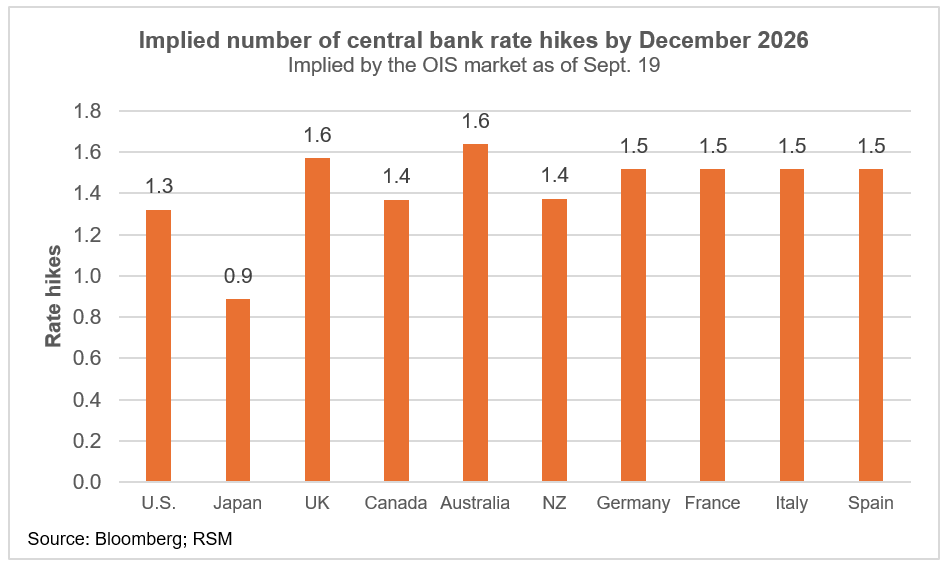
Central banks in developed economies are poised to raise their policy rates in response to rising inflation and recent energy shocks. Historically, these institutions have coordinated their actions during economic downturns, such as the financial crisis and the pandemic, to stabilize the global economy.
Read More
Currently, U.S. and UK inflation rates stand at 3.4%. In Canada, inflation is 3.0%, while Australia and New Zealand report rates of 3.2% and 4.1%, respectively. In the euro area, Germany's inflation is at 2.9%, France at 2.6%, and Spain at 4.6%. Italy's inflation rose to 3.2% after previously staying below 2% through 2024 and 2025.
The inflation rates reported are significantly higher than the past years’ disinflation and exceed the 2% targets set by central banks. Policymakers are concerned that rising inflation could reduce consumer spending and lead to economic hardship and potential recession. For financial markets, inflation diminishes expected investment returns, contributing to a decrease in real income and slower growth.
The overnight index swap (OIS) market, a preferred gauge for estimating rate hike expectations, indicates that central banks are expected to raise rates by at least one time by the end of the year, with additional increases anticipated in the U.S. next year. This aligns with predictions of synchronized global rate hikes.
Additionally, the global bond market is responding to inflation threats, with 2-year yields on the rise since the onset of the Iran conflict in late February. The U.S. 2-year bond yield is currently 4.8%, a significant 90 basis points above the effective federal funds rate of 3.9%, suggesting the possibility of three more rate hikes in the coming years.
Overall, a synchronized approach among central banks is expected, reflecting market consensus on possible global rate increases. A recent rate shock model for the U.S. economy emphasized that higher long-term yields, potentially exceeding 5%, may require central bankers to reassess their strategies to achieve the 2% inflation target.
Joseph Brusuelas serves as the chief economist for RSM, focusing on economic policies affecting midsize companies. With over 20 years of experience, he provides insights on U.S. and global economies to Congress and the financial media.