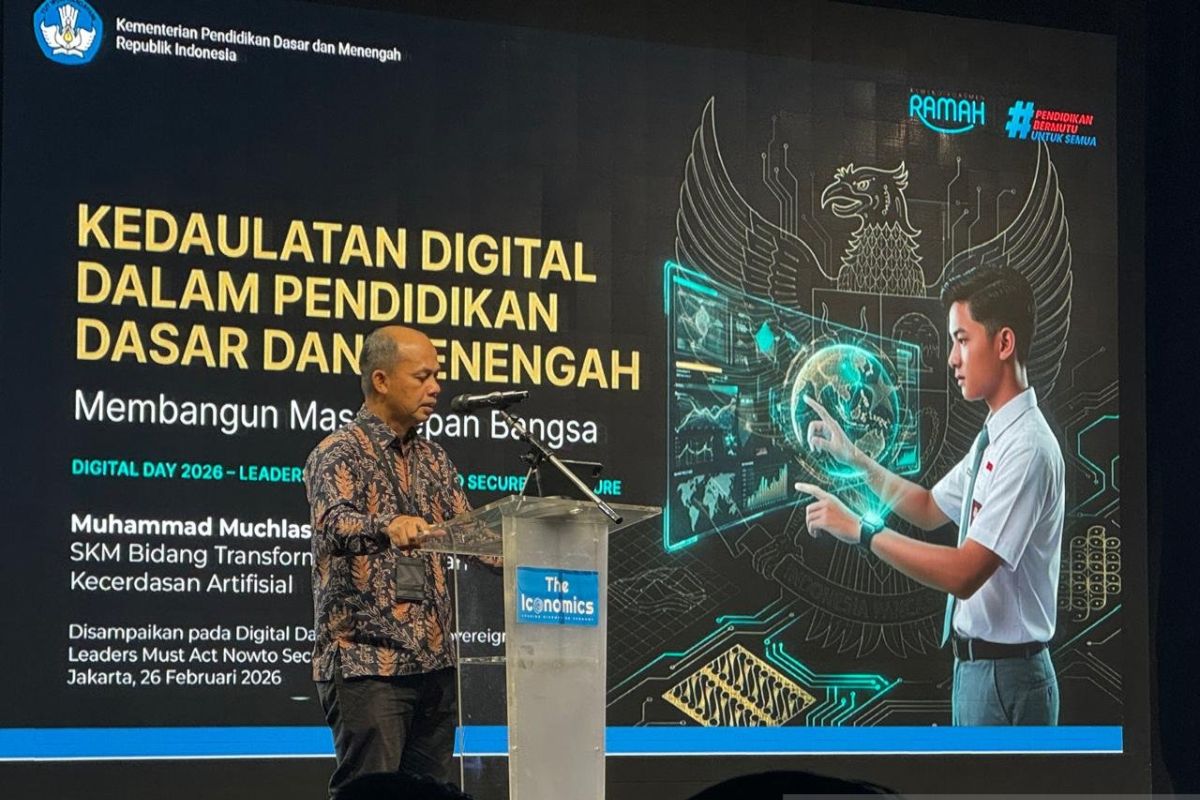
Muhammad Muchlas Rowi, Special Staff for Digital Transformation and AI at the Ministry of Primary and Secondary Education, attended the Digital Day 2026 event titled "Digital Sovereignty: Leaders Must Act Now to Secure the Future" in Jakarta on February 26, 2026. The event was organized by The Iconomics.
Read More
Artificial intelligence (AI) is becoming a pivotal factor in global economic competition, affecting not only work efficiency but also industrial productivity and economic competitiveness. For Indonesia, the primary challenge lies in accelerating AI adoption while ensuring citizens can master the technology to create value from it. This transition poses significant challenges for the national education system, particularly as the rapid pace of technological advancement can outstrip curriculum development, leading to a skills gap between graduates and industry needs.
Higher education institutions are expected to produce graduates who are not just educated but are also adaptable, critical thinkers capable of solving problems using technology. The increasing use of AI in student assignments and presentations showcases this challenge. While such applications offer convenience, they do not inherently confer a deep understanding of the technology. A lack of comprehension regarding data validity, algorithm limitations, and ethical considerations may adversely affect independent thinking.
To address these issues, education on AI must extend beyond mere usage to encompass a thorough understanding of competencies. Students should learn not only how the technology works but also when it is appropriate to use it, how to verify its results, and the extent of machine assistance in decision-making without diminishing human accountability.
A notable collaboration took place on October 19, 2026, between Sophia Training and Consulting, i3L University, and EduMark. The partnership aims to integrate AI learning materials into higher education while facilitating training for students and professionals. Sophia, a UK-based consulting firm, specializes in AI and data management; i3L University focuses on education and innovation; and EduMark is a Jakarta-based consultancy that fosters partnerships for workforce readiness. This collaboration serves as a model for addressing the digital competence gap, emphasizing the necessity of translating knowledge into applicable skills.
In terms of economic impact, AI education is directly correlated with labor productivity. Technology facilitates faster information processing, enhanced data analysis, and improved planning accuracy. However, simply implementing AI tools doesn't guarantee productivity gains; these benefits materialize only when technology is embedded within business processes, supported by quality data, and utilized by knowledgeable workers.
Upskilling and reskilling are urgently needed, not only for new graduates but also for existing workers. The training programs proposed by i3L underscore the importance of aligning educational offerings with industry requirements, focusing on real-world problem-solving rather than merely operating applications. Effective training should be evaluated based on participants' abilities to boost efficiency and innovate.
Moreover, AI education must take into account the specific needs of various professional fields. For instance, the requirements of an economic analyst differ from those of healthcare workers, educators, and entrepreneurs in the micro, small, and medium enterprise (MSME) sector. A general approach jeopardizes the depth of learning needed for effective application.
The accessibility of quality AI training is another pressing issue. If advanced education is restricted to large corporations, economic inequality may worsen. Partnerships among universities, government, and businesses are essential for creating inclusive training models. Furthermore, the governance of AI must be integrated into educational contexts to address concerns like data protection and algorithmic bias comprehensively.
Looking ahead, Indonesia should aim not only to be a user of technology but to become a developer as well. Reliance on foreign systems without enhancing local research capabilities may hamper economic value generation. Prospecting international collaborations could facilitate knowledge exchange, but success will depend on effective skill transfer and curriculum relevance.
Ultimately, Indonesia's ability to leverage AI for increased productivity and innovation hinges on adaptive educational policies and equitable access to digital skills. The nation's competitiveness will rely less on the number of AI users and more on how effectively technology enhances economic and social contributions. Sovereignty in the AI era involves having the knowledge and skills to manage and develop technology aligned with national interests, paving the way for productivity and progress.