WASHINGTON (AP) — Following a recent increase in its benchmark interest rate on Wednesday, President Donald Trump has criticized the Federal Reserve. However, economists suggest that broader economic trends, rather than the Fed’s actions alone, are influencing long-term borrowing costs.
Read More
Despite facing numerous challenges, the economy is experiencing steady growth, with inflation remaining high. Major technology firms are securing substantial loans to invest in data center construction, while the federal government continues to run significant yearly budget deficits. Analysts indicate these factors are likely to result in higher interest rates regardless of the Fed's decisions.
The era of low interest rates and low inflation that prevailed for almost 15 years post-Great Recession has ended, making way for a new environment marked by higher rates. Mortgage rates, which fell into the 3% range during the 2010s and even lower amid the COVID-19 pandemic, have now surged. The average rate for a 30-year mortgage reached 6.95% last week, the highest in over a year and a half.
Joe Brusuelas, chief economist at RSM, attributes this shift to a transition from a pre-pandemic economy characterized by weak consumer and business demand to one where robust spending is colliding with supply shocks. Compounding this are rising oil prices due to the war in Iran and an ongoing shortage of computer chips and workers necessary for the AI industry.
"We've undergone a structural transformation of the economy," Brusuelas said, noting that this reflects the changes in inflation and interest rates.
The current economic landscape mirrors conditions prior to the financial crisis that lasted from December 2007 to June 2009. However, even post-crisis, consumer and business spending had remained sluggish, as many individuals focused on reducing debt. In contrast, big tech companies like Alphabet's Google and Meta's Facebook are now utilizing their cash reserves to build AI infrastructure while concurrently borrowing additional funds.
Interestingly, American consumers, despite some pessimism about the economy, are maintaining healthy spending levels. A recent report showing an increase in retail sales prompted economists at Bank of America to predict a growth rate of 3% for the July to September quarter.
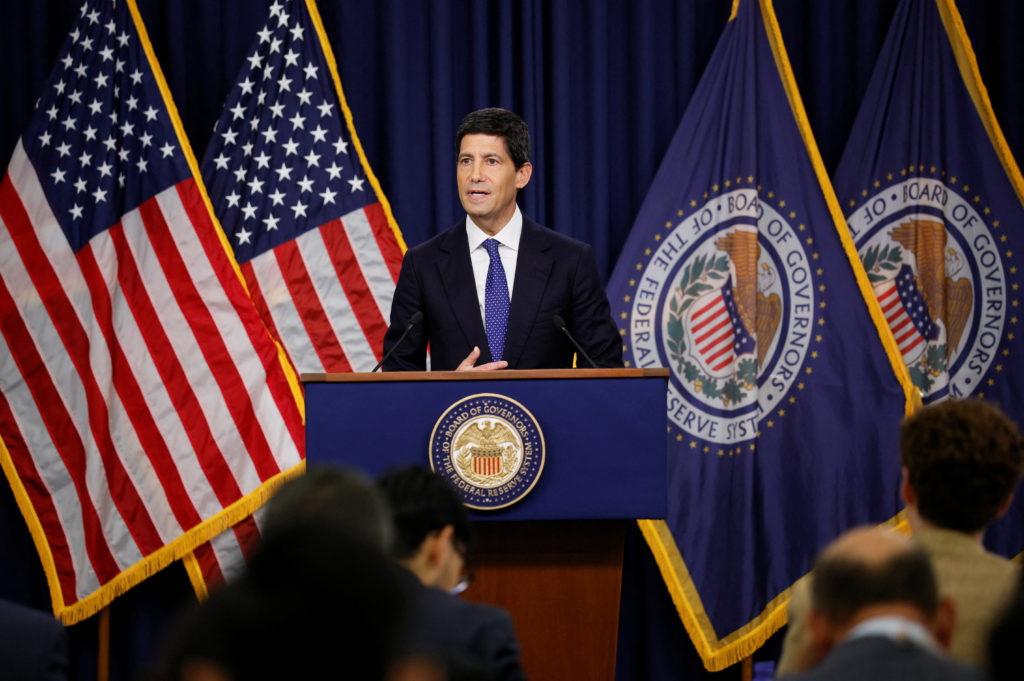
Federal Reserve Chairman Kevin Warsh addressed the economic shift during a speech at the central bank's annual conference in Jackson Hole, Wyoming last month. Following the 2008 crisis, he stated there was a widespread belief that a surplus of capital would remain uninvested due to a lack of enticing opportunities. Now, investments are actively flowing into the infrastructure needed for AI.
This surge in spending has contributed to rising longer-term interest rates on government bonds, which are competing for lenders. The yield on the 10-year Treasury bond surpassed 5% this year for the first time since 2023, even prior to the Fed’s latest rate hike.
Despite this economic expansion, political polls and consumer sentiment surveys indicate that many Americans are struggling with rising prices. Inflation has outpaced average wage growth for the past five months, raising affordability concerns as midterm elections approach.
Brusuelas described the current economic growth as "imbalanced," reliant on the AI sector's expansion and robust spending by wealthier consumers benefitting from rising stock prices.
In response to the Fed's rate hike to 3.9%, Trump called for a target of just 1%. However, many of the policies enacted during his administration have contributed to higher borrowing costs, particularly the war in Iran, which has escalated gas prices. When inflation remains persistent, investors demand higher rates on longer-term Treasury bonds, influencing mortgage rates accordingly.
"The president can say he wants interest rates lower all he wants, and yet he continues to push the button on all the policies that raise rates," said Elizabeth Pancotti, vice president of policy, advocacy, and research at the Groundwork Collaborative.