The Nobel Prize in Economics for 2026 will be announced on October 12. Current predictions from Polymarket indicate that Ariel Pakes is the frontrunner with an 18.5% chance of winning, followed by Michael Woodford at 12.0%. Clarivate’s Citation Laureates list this year includes notable figures in information technology economics, monetary policy, and organizational innovation. Woodford is recognized for his contributions to monetary policy theory and practice. Historically, 89 Citation Laureates have gone on to receive the Nobel Prize since 2002, which underscores Woodford's relevance to the committee's considerations.
Read More
Predictions suggest that Woodford, Jordi Galí, and Olivier Blanchard may win for establishing a modern framework for monetary policy analysis. An alternate possibility includes Steven Berry, James Levinsohn, and Ariel Pakes for their work on demand estimation in differentiated-product markets and empirical antitrust methodologies.
The contributions of Blanchard, Galí, and Woodford represent a significant shift in macroeconomic thinking. For over two decades, macroeconomics had polarized; traditional Keynesian ideas viewed the economy as a mechanical system where policymakers could trade off unemployment and inflation. However, the phenomenon of stagflation in the 1970s challenged this notion.
In response, New Classical economics and Real Business Cycle (RBC) theory presented models where wages and prices adjusted immediately, suggesting that recessions were simply technology setbacks and workers actively chose leisure over work.
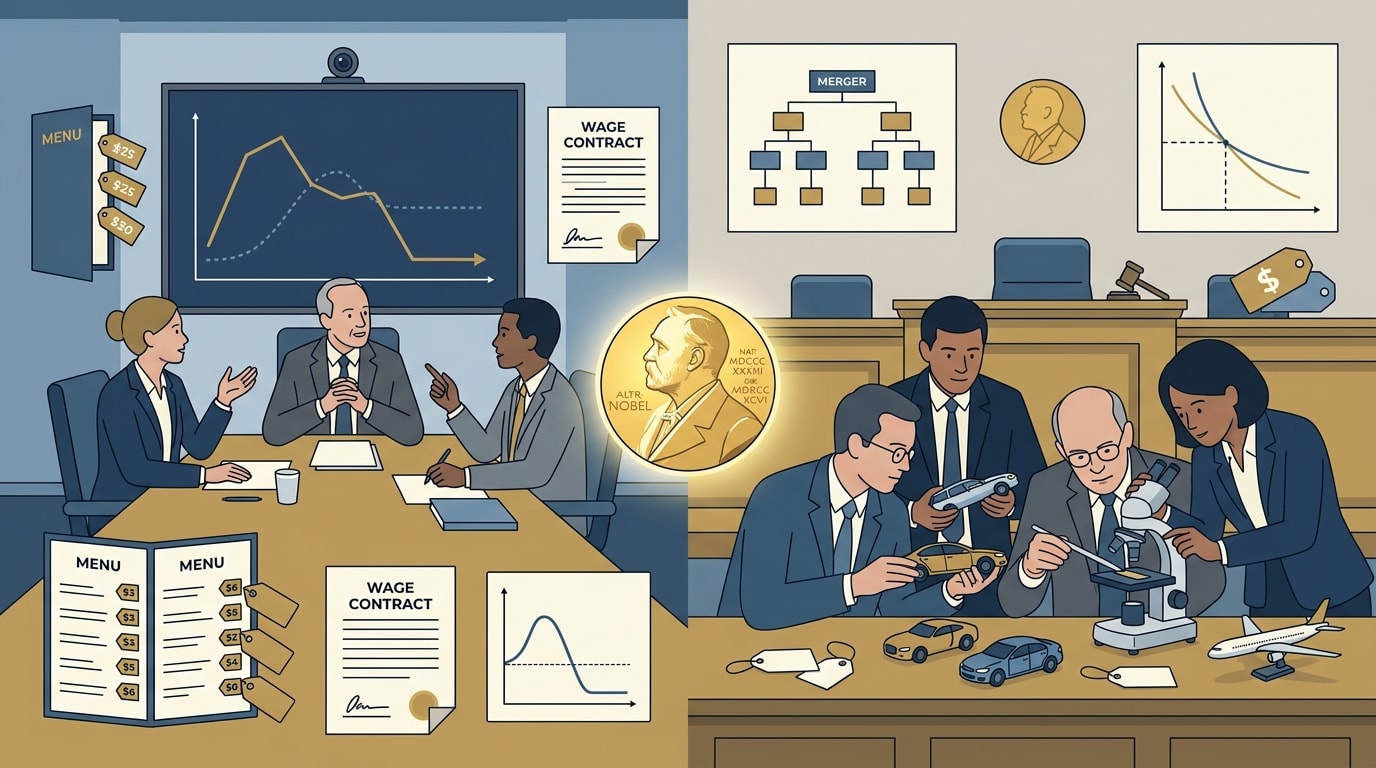
Blanchard introduced the idea of menu costs and aggregate demand externalities, arguing that while prices may be theoretically flexible, firms do not constantly adjust them. This delay in price changes across many firms can lead to significant declines in output and employment.
Galí built on this by developing the New Keynesian model now widely used by central banks. His empirical research indicated that positive technology shocks might initially reduce total labor hours, contradicting the RBC perspective that technology is the sole driver of economic booms. He also formalized the Taylor principle, which states that nominal interest rates should rise more than inflation rates to elevate real rates, a crucial adjustment seen during the inflation of the 1970s.
Woodford's influential perspective shifted focus from controlling money supply to managing expectations. He emphasized that central banks should concern themselves with the overnight interest rate and public expectations about future rates, a concept crucial for mortgage and investment decisions. His work has garnered significant academic recognition, with around 74,000 citations to his research.
The practical implications of this framework were evident during the financial crises of 2008 and 2020, when major central banks resorted to forward guidance to manage monetary policy in a zero lower bound environment.
In another vein, Berry, Levinsohn, and Pakes transformed industrial organization economics through their 1995 paper on automobile pricing, which allowed regulators and economists to better model demand in differentiated markets. Their work has enabled antitrust authorities to simulate how mergers might impact prices and consumer welfare.
While Pakes currently leads in predictions, none of the BLP team are on the 2026 Citation Laureates list, indicating that the Nobel committee may lean more towards acknowledging contributions to macroeconomic policies this year. However, the BLP model’s significance suggests they could be strong contenders in future awards.
In summary, Woodford, Blanchard, and Galí are likely to be recognized for their foundational work in modern monetary policy analysis, which has changed the landscape of economic decision-making. If the academy opts for microeconomic recognition instead, the BLP team might be next in line for future honors.