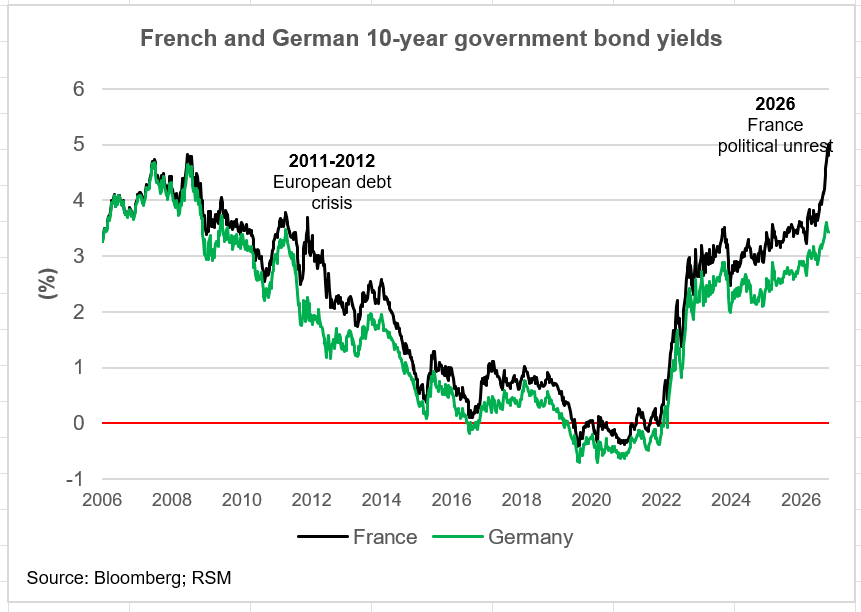
Expansionary fiscal policies and increasing interest payments on government debt are driving long-term yields higher across the European Union, presenting significant political and economic challenges. France’s situation may serve as a warning for other G-7 nations and potentially the United States.
Read More
On October 21, the yield spread between French and German bonds widened to 159 basis points, a striking contrast for the world's seventh-largest economy with a GDP of $3.6 trillion. This shift reflects growing investor concerns about French debt, which has surged to nearly 120% of GDP. Consequently, this repricing of risk is likely to elevate capital costs in France and across the European Union.
Small and medium-sized business executives might underestimate the impact of global debt market instability, but they are likely to feel its effects. The new norm of higher inflation and interest rates, which has emerged since the pandemic, is expected to persist as investors demand higher risk premiums for holding developed economies' debt, particularly that of France.
Historically, France managed its debt cautiously, but it recently exceeded 100% of its annual GDP, a figure the International Monetary Fund predicts will continue to grow. Initial fiscal prudence observed during President Emmanuel Macron’s early tenure has diminished, giving way to more populist spending proposals, viewed by global investors as reckless.
The current yield spread, with French OATS yielding 5.01% compared to safer German Bunds at 3.42%, exemplifies investor demands for increased risk compensation. The situation mirrors past eurozone crises, shifted from smaller economies like Portugal and Greece to developed nations including France, the UK, Germany, and the U.S., raising alarms among investors.
As the spread between French and German 10-year debt approaches levels seen during past crises, concerns grow that the French political system is not prepared to manage a potential bailout. Factors contributing to this turmoil include expansionary fiscal policies that further complicate the situation ahead of the French elections next April.
Potential pathways to manage government debt and reduce yields include:
1. **Fiscal consolidation**: Successful examples from the past show that developed economies can stabilize their fiscal paths, leading to lower yields. However, current economic populism in France makes such a transition challenging.
2. **Running the economy hot**: This approach, reminiscent of post-World War II policies, could lower the real value of existing debt through high inflation. However, strict monetary policies limit France's ability to pursue this option effectively.
3. **Financial repression**: Central banks have used large-scale asset purchases to stabilize economies post-pandemic, but France's current financial strategy does not position it to benefit from this approach due to rising interest rates.
4. **Debt cancellation**: This concept involves a government declaring an inability to repay its creditors, potentially leading to high inflation and dire consequences for economic stability.
5. **Default/restructuring**: This complex solution involves partial or complete default and could occur if France’s fiscal situation continues to deteriorate.
As discussions around these options arise, it is evident that significant financial strain might be necessary for France’s political entities to negotiate a coherent fiscal strategy. Meanwhile, the European Central Bank's current reluctance to intervene suggests that immediate relief for French debt is unlikely.
In the backdrop, one election candidate’s proposal to cancel 18% of France's debt owed to the central bank highlights the peril of economic populism. Currently, while contagion risks are rising, the ECB's willingness to use its Transmission Protection Instrument to buy French debt remains uncertain.
The ongoing global bond market turmoil invites scrutiny of fiscal policies in countries with unsustainable budget deficits. Policymakers, especially in the U.S., may need to learn from France's unfolding situation to avoid a similar crisis.