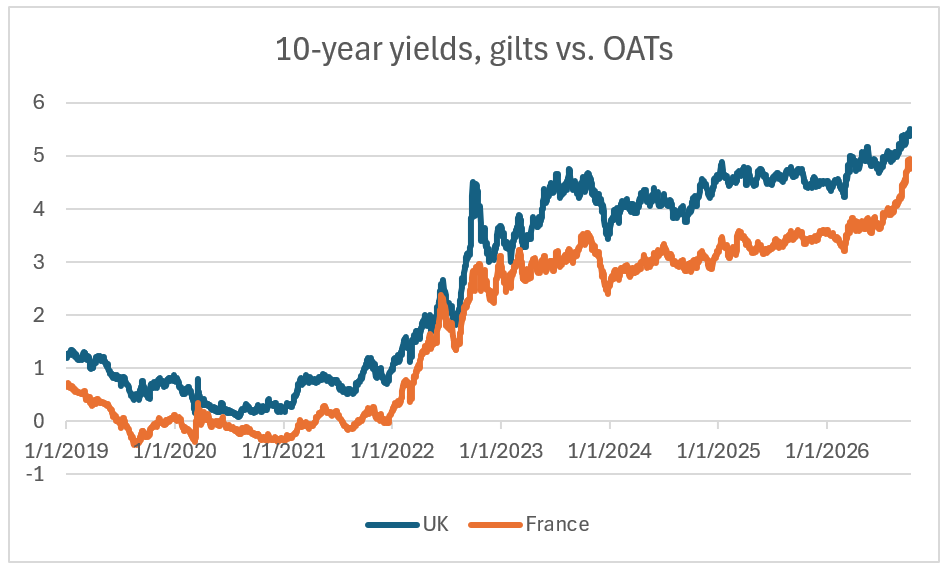
France’s government bond market presents a cautionary example for UK Chancellor of the Exchequer John Healey as he prepares for the upcoming budget at the end of the month. Deterioration in fiscal credibility can happen swiftly if investors question a government's ability to manage borrowing.
Read More
This year, the yield on UK 10-year gilts has increased by one percentage point, while the yield on a 10-year French government bond, known as an OAT, has surged nearly 1.4 percentage points to around 5%. Despite the rise, France is still paying slightly less than the UK—approximately 4.9% compared to 5.4%—even with a higher debt-to-GDP ratio, a larger deficit, and sluggish growth.
The discrepancy partly stems from lower interest rates in the eurozone and the implicit support from other eurozone countries, notably Germany. A more telling measure of investor unease is the spread over German Bunds, which has reached 150 to 160 basis points, levels not observed since the eurozone debt crisis between 2010 and 2012.
France’s fiscal challenges extend beyond the size of its deficit; it is targeting a deficit of 5.0% of GDP next year, down from an estimated 5.4% this year, with public debt standing at about 119% of GDP. Although the government has proposed significant fiscal consolidation, political fragmentation has cast doubt on its ability to implement these reforms.
Recent political instability in France demonstrates how uncertainty can exacerbate fiscal issues. For the UK Budget, the costs of inaction are stark, with fiscal headroom reported to have fallen from £23.6 billion in March to approximately £12 billion; higher gilt yields account for around £10 billion of this decline. This leaves little flexibility for a Budget that could either increase spending or make tenuous promises of future tax hikes, both of which would lead to further borrowing uncertainties.
Healey should refrain from depending heavily on temporary measures that might inflate borrowing in the short term without addressing fiscal rules. France illustrates the importance of both the composition and credibility behind fiscal consolidation. A credible medium-term debt strategy that rests on realistic spending forecasts and growth-inducing measures could help ease investor concerns.
It is crucial that Healey maintains sufficient fiscal headroom. An approach returning toward £10 billion might seem politically attractive, yet it comes with significant fiscal risks. Conversely, a multifaceted Budget that seeks to push fiscal policy in several directions could put the UK in a similar position as France, facing rising yields, increased debt servicing costs, and diminished fiscal headroom. This serves as a reminder that loss of confidence can result in rapid changes in financial dynamics.