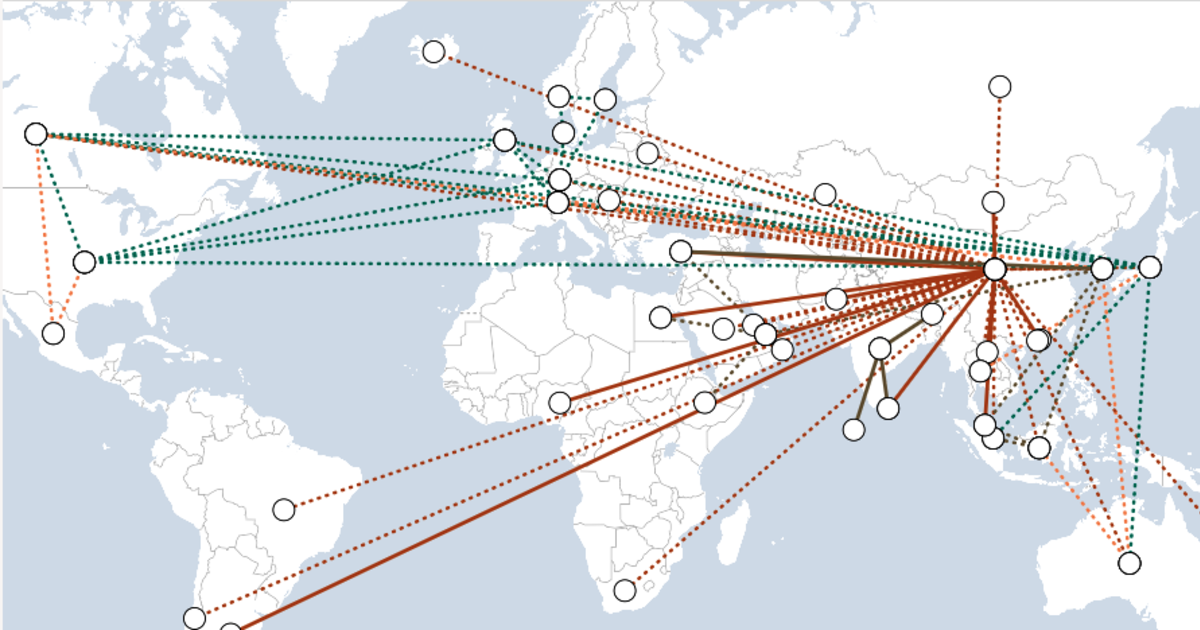
Since the 2007 financial crisis, central banks globally have engaged in numerous bilateral currency swap agreements, allowing them to exchange domestic currency for foreign currency. This arrangement enables the recipient central bank to lend foreign currency to domestic banks as needed. The U.S. Federal Reserve's swaps played a crucial role during both the financial crisis and the COVID-19 pandemic by addressing dollar shortages among non-U.S. banks. In recent years, China has also sought to establish itself as a global lender by extending swap lines to countries facing financial difficulties.
Read More
The mechanics of a currency swap involve an initial exchange where one central bank trades its currency for another. The recipient can then lend the foreign currency to domestic banks, addressing shortages. Repayment occurs at a future date, along with interest. Swap lines can be either unidirectional, meaning only one central bank provides liquidity, or reciprocal, where both central banks can provide liquidity to each other. Though they primarily serve as hedges against currency fluctuations, these agreements carry risks, as trust and reliability are paramount.
The U.S. Federal Reserve started its first swap lines in December 2007, partnering with the European Central Bank (ECB) and the Swiss National Bank in response to rising demand for dollars from European banks. This was followed by further extensions to other central banks as the crisis unfolded. Lending through these arrangements hit a high of $586 billion in December 2008, aimed at preventing a meltdown through liquidity provision.
During the COVID-19 pandemic in March 2020, the Federal Reserve again activated swap lines, reducing interest rates to facilitate access to the dollar for domestic and counterpart central banks. The economic downturn led to significant reliance on these lines, with Japan being the largest user, peaking at around $225 billion.
The ECB also engaged in swaps during both crises; it initially established lines in 2007 to assist banks in Sweden and Denmark. These swaps were used to bolster foreign exchange reserves under considerable stress during the 2008 crisis and again as the pandemic unfolded. New swaps were established with other countries as preventive measures, although most were not activated during the pandemic due to relatively stable market conditions for euros.
The People's Bank of China (PBoC) has approached currency swaps differently, strategically broadening its network to over 40 countries since 2009. These swaps are intended to promote trade and mitigate national debt pressures, often serving as alternatives to more conventional lending. Countries like Argentina and Pakistan have relied heavily on PBoC swaps amid economic difficulties. For instance, Argentina utilized a swap in 2023 to stabilize its currency during a crisis.
The future of such agreements presents challenges and potential risks. The perception that central banks will always provide liquidity may foster dangerous currency mismatches, particularly among European banks. While the Federal Reserve and ECB focus on temporary dollar shortages, the PBoC's broader involvement in developing economies raises questions about structural adjustments to debt issues. The implications of these arrangements continue to unfold, with significant impacts on global financial stability.