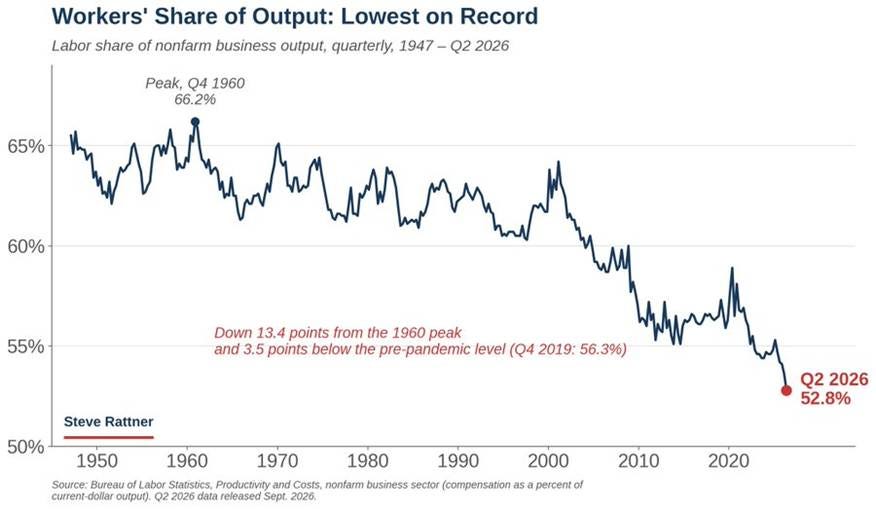
Steve Rattner, an economic analyst and former advisor to President Obama, recently shared a chart illustrating the declining labor share of economic output, which has reached its lowest point on record in 2026. This trend has been misinterpreted by some to suggest a deterioration of worker welfare and increased wealth disparity.
Read More
The decline in labor's share of national output, noted by various observers, reflects the nature of capital income as a residual of multiple factors. The Bureau of Economic Analysis categorizes income into different types. Many assessments of capital share use gross income figures that incorporate depreciation costs related to maintaining capital stocks. Consequently, the rising capital share may indicate a more capital-intensive economy, which includes these depreciation expenses, rather than simply an increase in economic rent for wealthy owners.
Another contributing factor to the drop in labor's income share is the growing international competition American industries face. Since 1970, imports have risen from 5 percent to about 15 percent of GDP, signaling a deeper integration of domestic firms into global supply chains. This increased competition and the offshoring of labor-intensive production have shifted some domestic income towards capital and intangible assets instead of labor. For example, while iPhones sold in the U.S. are designed here, they are assembled overseas.
Research, including a 2013 Federal Reserve working paper, has indicated that offshoring accounts for approximately 3 to 4 percentage points of the labor share decline over 25 years. However, a significant factor behind this perceived income gap is the mismeasurement of wages for the self-employed, which has contributed to about one-third of the decline in labor's share.
Despite these issues, there is reason for optimism regarding the implications of a growing capital stock. The period characterized by a declining labor share has also seen rising real wages and improvements in living standards and access to capital ownership for workers. For instance, if labor income increases from $60 to $110 while national income rises from $100 to $200, workers experience improved compensation and job opportunities even as labor's share of national income decreases from 60 to 55 percent.
The growth in capital has significantly boosted worker productivity, with the typical American worker today twice as productive as in the early 1990s, three times more productive than in 1970, and four times more than in the 1950s. Modern construction workers, for example, utilize advanced technology that enhances their productivity compared to past methods.
Another important change is the transformation in ownership of investment assets. In 1975, only one in eight Americans owned stocks or mutual funds, compared to about six in ten today, including those invested through retirement accounts. Consequently, the average value of pooled investment funds for American families has increased over eight-fold since 1989. The proportion of families' financial assets in retirement and investment funds has risen from 26 percent to 58 percent, indicating that many Americans now derive a significant portion of their income from investments rather than wages.
In summary, the labor share of economic output is not an accurate metric for assessing worker welfare or the wealth of billionaires. It conflates relative income shares with absolute gains and overlooks the increasing ownership of capital among average Americans, along with the impacts of globalization and self-employment income. While narratives of doom may resonate more in public discourse, the overarching data reveals positive trends: capital accumulation, enhanced productivity, broader investment ownership, and technological advances have led to substantial improvements in the living standards of everyday Americans.