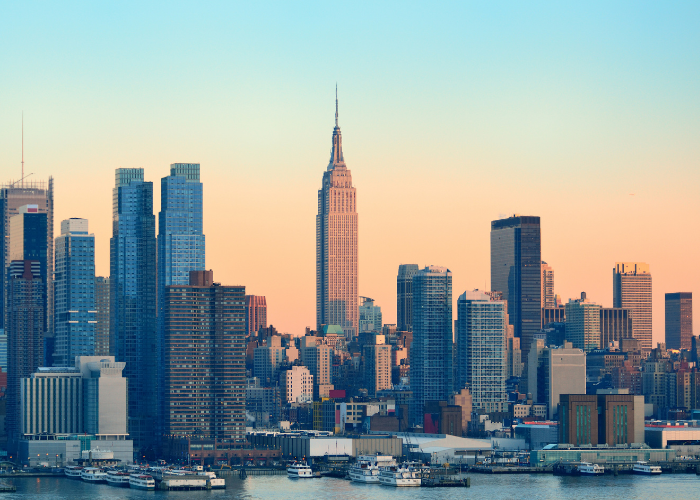
The Oxford Economics Global Cities Index has ranked the world's 1,000 largest cities across five categories: Economics, Human Capital, Quality of Life, Environment, and Governance. The Economics category is particularly significant as it not only assesses the size of a city's economy but also its stability, growth trajectory, and the distribution of economic benefits among residents.
Read More
This year, New York retains its position as the largest economy globally, bolstered by a strong first-place ranking in Economics due to its substantial metro economy, which is nearly double that of Tokyo and Los Angeles. Despite a lower economic diversity compared to some peers, primarily due to its finance sector's dominance, New York is expected to maintain its top ranking for the foreseeable future.
The United States dominates the rankings, with nine out of the top ten cities located there. Los Angeles follows New York in second place, benefiting from a diverse economic base that includes entertainment, technology, and aerospace. San Jose ranks third, thanks to its concentration of prominent tech companies, such as Apple, resulting in the highest GDP per capita among the indexed cities.
In Europe, London is the leading economic city, holding the fourth position globally, backed by stable growth. Other notable European cities include Dublin at 12th, recognized for its high GDP per capita, and Paris at 13th, noted for its cultural significance and service-oriented economy.
Emerging cities in Asia are rising rapidly in the rankings. Bengaluru, India, is noted for its fast expansion driven by the IT sector, while Ho Chi Minh City has gained significant GDP growth through trade and manufacturing. Cities like Kuala Lumpur and Shenzhen are also positioned as critical players in the global AI landscape.
Economic growth is not limited to Asia; cities in Africa, such as Port Said and Suez, are experiencing fast growth rates, largely due to their strategic locations along the Suez Canal. In Latin America, Lima stands out as the top economic city in the region, showing promising growth indicators.
Riyadh in the Middle East has seen robust growth due to diversifying its economy away from oil, while Abu Dhabi and Dubai are also expanding their economic bases.
Overall, the index highlights that a city's economic strength is determined by various factors, including scale, growth speed, and resilience, with both established and emerging cities competing for prominence in the global economy.