Ongoing macroeconomic shifts, geopolitical tensions, and persistent inflation are driving significant volatility across various asset classes. Traditional balanced multi-asset portfolios have seen increased co-movement among asset classes, leaving investors exposed to systemic corrections.
Read More
This article discusses defensive positioning strategies for investors by combining monetary-hedging real assets with structural investments in clean energy. This approach aims to provide effective countermeasures against market volatility.
Global financial markets are currently navigating a structurally altered landscape characterized by inflationary pressures, high sovereign debt, and geopolitical realignments. During this time, correlations between equities and bonds have become more positive, reducing the safe-haven advantages that long-duration sovereign fixed income typically provides. In such an environment, investments in real assets and sector-specific infrastructure can offer strong diversification benefits.
Investing in gold and energy assets addresses two key vulnerabilities in today’s market: monetary debasement and supply-side constraints. Commodity exposures can hedge against input-cost shocks, while physical assets shield capital from fluctuations in the broader financial system and real interest rates.
Analyzing the macroeconomic factors affecting gold and energy infrastructure reveals their complementary roles in stabilizing portfolios. Central banks continue to acquire gold, now at record levels, to diversify their reserves away from foreign currencies. Gold operates without counterparty risk and serves as a monetary safeguard during geopolitical crises.
Gold prices typically decline in response to expected real yield increases. When central banks implement easing measures despite inflation, real yields decrease, minimizing the opportunity cost of holding gold.
Modern energy infrastructure, particularly in nuclear power, ensures stable revenue from long-term power purchase agreements (PPAs). As technological demands increase for consistent electricity supply—particularly from AI and cloud computing—energy infrastructure will experience robust demand.
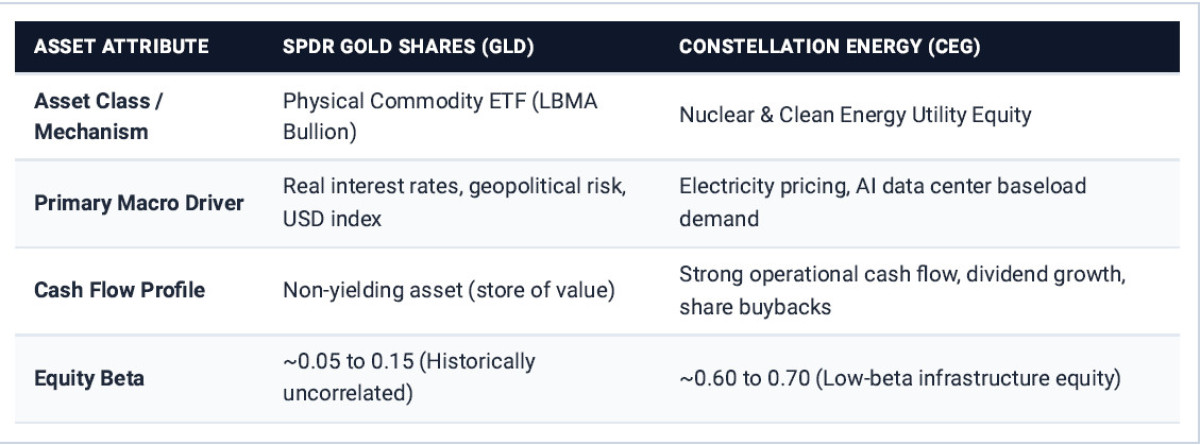
The investment profiles of SPDR Gold ETF (GLD) and Constellation Energy (CEG) illustrate how exposure to physical assets and infrastructure deployment complement each other amid varying economic conditions. The correlation between precious metals and clean energy infrastructure remains low, providing a buffer during economic volatility.
A strategic pairing of GLD and CEG offers a dual-layer defense against systemic monetary risks and real-economy transitions. While traditional utility stocks may lack growth potential, CEG capitalizes on nuclear assets to supply high-margin electricity contracts to data centers. GLD functions as a shock absorber, preserving liquidity during periods of equity sell-offs, while CEG may experience co-movement with broader market changes.
For investors seeking to mitigate volatility, a tailored allocation strategy is essential. In a conservative-growth mandate, a 60% allocation to GLD and 40% to CEG within the real-asset segment can optimize defense against drawdowns while allowing for capital appreciation. Regular rebalancing between these assets enables investors to benefit from gold price rallies and reinvest in energy infrastructure during equity declines, thus strengthening long-term portfolio returns.
In summary, the ongoing macroeconomic challenges combined with geopolitical tensions are intensifying asset volatility. By strategically pairing gold and energy infrastructure, investors can better position themselves defensively. This analysis highlights the benefits of combining the SPDR Gold Shares ETF (GLD) with Constellation Energy Corporation (CEG), leveraging GLD's stability during crises and CEG's potential for growth driven by increasing power demands. This strategic allocation is designed to enhance overall portfolio performance during turbulent market conditions.