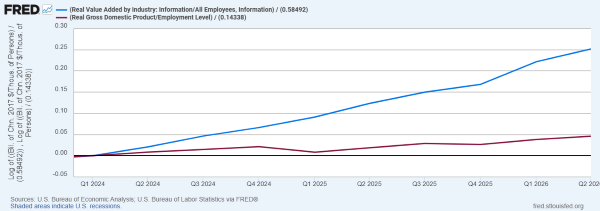
Labor productivity in the information sector has recently shown significant growth, outpacing both historical trends and overall economic performance. Since the introduction of generative AI tools like OpenAI's ChatGPT and Microsoft's Copilot in early 2024, the data indicate a notable increase in productivity.
Read More
Labor productivity measures output per worker, and current data from the Federal Reserve Economic Data (FRED) illustrates this trend. The information sector, which encompasses publishing, broadcasting, telecommunications, and data processing, has witnessed labor productivity growth of 13.70% from Q2 2025 to Q2 2026, compared to a mere 2.17% growth in aggregate productivity over the same period.
Historically, the information sector has maintained higher productivity rates than the overall economy, with an average annual productivity growth of 7.68% from 2010 to 2026, against a national average of 1.22%.
These early productivity gains suggest that generative AI may be contributing positively to efficiency within the information sector, despite it only accounting for 1.8% of total employment. This sector's productivity has traditionally played an essential role in driving economic growth.
The data used for this analysis was adjusted for visualization purposes, utilizing a natural logarithm to depict growth trends clearly. For those interested in the methodology behind the graphs, the series on FRED were structured with specific formulas to reflect real value added and employee levels.