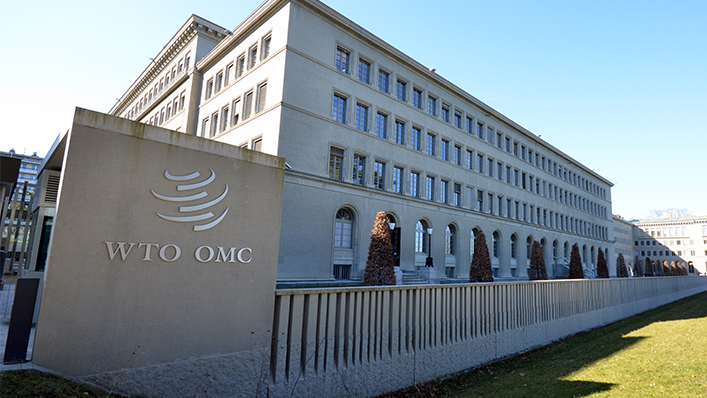
ASTANA – After eleven years as a member of the World Trade Organization (WTO), Kazakhstan has expanded its trading horizons significantly under established international rules. However, the country continues to grapple with a primary challenge: reducing its reliance on commodity exports.
Read More
Kazakhstan became the 162nd member of the WTO in 2015 following nearly two decades of negotiations. The past eleven years have provided insights into how well the economy has integrated into global trade and whether increased market access has led to a more varied export base.
During a September briefing, Minister of Trade and Integration Arman Shakkaliyev noted that 98% of Kazakhstan’s trade now occurs with WTO member nations, highlighting the organization's critical role in global trade.
Sagyndyk Kosherbayev, director of the Center for Trade and Investment Policy at the Economic Research Institute in Astana, views the country's WTO accession as a pivotal moment in its economic integration. He reported that by the end of 2025, Kazakhstan’s foreign trade turnover is expected to reach $144.7 billion, marking an 89% increase since 2015. Over the same timeframe, exports have risen by 72%, and imports have more than doubled. The WTO members observed during Kazakhstan’s first Trade Policy Review in 2024 that trade volumes roughly doubled since accession.
Kosherbayev cautioned against directly linking this growth solely to WTO membership, suggesting instead that its impact lies in the alterations it made to trading conditions. He pointed out that Kazakhstan remains a significant exporter of commodities, with its foreign trade value closely tied to global prices for oil, metals, and uranium. Other factors such as the formation of the Eurasian Economic Union, geopolitical dynamics, fluctuations in exchange rates, transport limitations, and shifts in trade flow geography have also influenced trade dynamics.
Kazakhstan’s WTO membership has yielded notable benefits, particularly in the form of more stable market access, lowered tariffs, and streamlined customs processes. According to Kosherbayev, the average applied most-favored-nation tariff decreased from 7.8% in 2015 to an anticipated 5.6% in 2025, enhancing import conditions for equipment and production inputs. Improvements, such as electronic customs declarations and a single-window system for import-export operations, have simplified trade procedures.
While the WTO provides a framework for trade, Kosherbayev emphasized that its membership mainly offers predictability for investors exploring export-oriented operations. As part of its WTO commitments, Kazakhstan recently engaged the dispute settlement system, requesting consultations with Indonesia over import duties on hot-rolled steel coils, asserting that they might contravene various trade agreements.
Despite these gains, the structure of Kazakhstan’s exports has not radically transformed. In 2025, crude oil is predicted to account for about 50.5% of Kazakhstan’s merchandise exports, while radioactive elements, refined copper, and ferroalloys also make up significant portions. This concentration indicates that while WTO membership has facilitated access to markets, it has not drastically diversified export offerings.
Kosherbayev highlighted that the onus of export diversification fundamentally lies within the domestic economy, necessitating competitive businesses, technological advancement, and compliant production to succeed in international markets.
The context of global trade is becoming increasingly complex, with pressures from protectionism, geopolitical tensions, and new U.S. trade policies disrupting established norms. Nevertheless, around 72% of global merchandise trade continues to operate under WTO regulations, underscoring the organization's enduring value.
As the WTO navigates its evolving challenges, Kazakhstan’s future trade strategy should pivot toward enabling its businesses to move beyond commodity exports and compete effectively in higher-value markets. Kosherbayev remarked that the effectiveness of Kazakhstan’s trade policy should increasingly be assessed by the competitiveness of its businesses in the international arena.