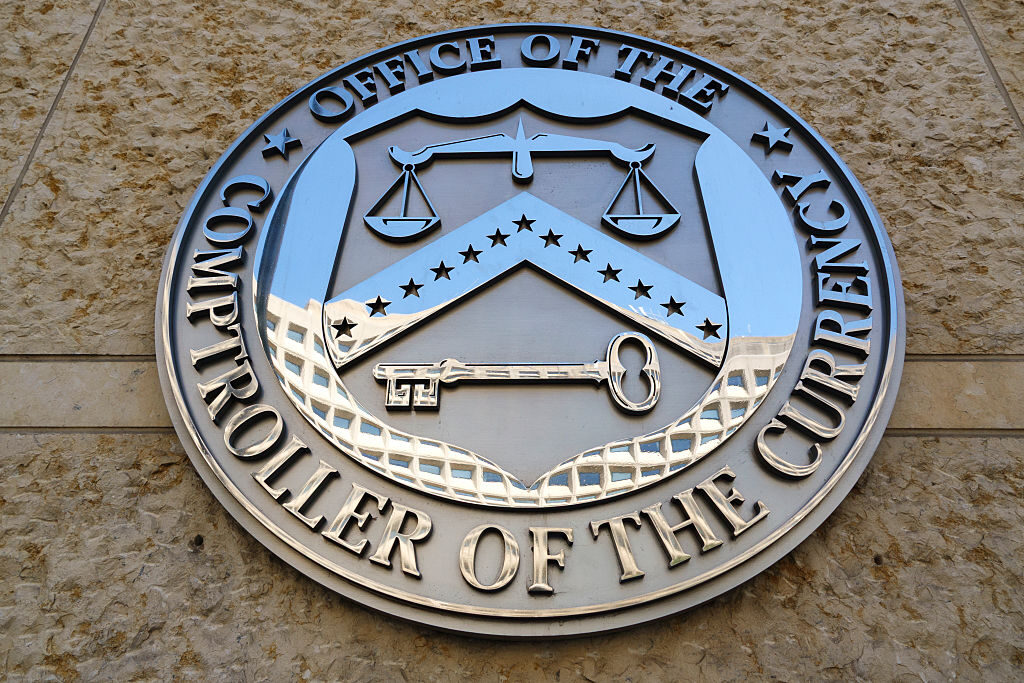
Banking industry representatives responded critically after regulators finalized a rule addressing a legal gap related to cryptocurrency exchanges' ability to pay interest on stablecoin holdings.
Read More
The 2022 legislation known as the “GENIUS Act” established a regulatory framework for stablecoins, which are digital assets linked to stable assets like the U.S. dollar. This framework was designed to reduce the volatility seen in cryptocurrencies like bitcoin.
While the law prohibited stablecoin issuers, such as Circle and Tether, from offering interest payments to attract depositors, it permitted third-party intermediaries, mainly crypto exchanges, to potentially provide such yield-bearing options.
The Office of the Comptroller of the Currency (OCC) clarified that crypto exchanges like Coinbase and Kraken are not allowed to offer interest or rewards merely for holding stablecoins. However, activities related to stablecoins may be permissible on a case-by-case basis, though a specific list of acceptable use cases was not provided.
Experts suggested that participating in “liquidity pools” on platforms like Uniswap could qualify as an eligible activity, whereby users deposit stablecoins to facilitate liquidity and can earn trading fees. Such arrangements may not trigger compliance issues under the new rule.
This approach marks a significant change from an earlier proposed rule that broadly banned interest arrangements while allowing the industry to argue why certain activities should be considered lawful.
The American Bankers Association expressed disapproval of the OCC's decision, stating that, while some aspects of the rule were positive, it ultimately preserved advantages for crypto platforms despite Congressional intentions to protect traditional lending. ABA President and CEO Rob Nichols emphasized the need for clarity on stablecoin yield.
The Blockchain Association urged the OCC to remove a provision placing the burden of proof on the industry to justify why their activities would not violate the yield prohibition. They praised the final rule for aligning more closely with Congressional intent.
Legal expert Steve Gannon noted that the final rule would simplify the process for stablecoin issuers to justify offering yields based on legitimate uses, implying that uncertainty in describing these activities could indicate a lack of eligibility for yield payments.
The ongoing legal ambiguity regarding stablecoin yield is intertwined with the broader discussions on crypto legislation stalled in the Senate, including a bill that seeks to clarify what activities could qualify for incentive payments.
This Senate bill would require regulators to define acceptable rewards based on legitimate activities that are distinct from traditional interest payments within a year of its passage. Additionally, it includes a provision that would allow regulators to prohibit yield payments if local community banks, defined as having less than $10 billion in assets, experience destabilizing deposit outflows.
These developments may pave the way for a streamlined “Clarity Act” to be considered in future legislative sessions.