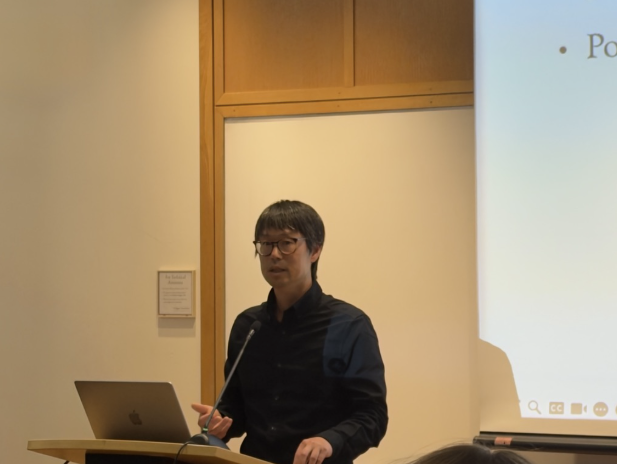
Gene Park, a Professor of Political Science and International Relations at Loyola Marymount University, delivered a lecture at Colgate University on September 24, exploring the dynamics of populism and central bank independence in the United States and Japan. Park, who directs the Global Policy Institute at LMU and has conducted significant research in public policy, international relations, and Japan’s economy, drew from his experiences as a visiting researcher in Japan’s Ministry of Finance for his analysis.
Read More
In his lecture, Park emphasized the role of central banks as legally independent entities responsible for currency issuance, monetary policy implementation, and lending support to commercial banks in times of need. He noted that politicians often prioritize short-term economic gains to influence public opinion ahead of elections, which creates challenges for effective monetary policy.
Park remarked on the increasing complexity of global financial systems, stating, "The world is much more financially developed," with finance playing a more significant role in the economy and capital moving rapidly across borders.
He described populism as a lens through which the perceived power of central banks is interpreted, explaining that it typically involves a narrative of virtuous people opposing a corrupt elite. He compared the populist rhetoric of the Trump administration with that of Japanese Prime Minister Sanae Takaichi, particularly focusing on how Trump critiqued figures within the Federal Reserve, such as Lisa Cook and Jerome Powell.
Park highlighted that Trump sought to undermine the Federal Reserve's independence to achieve specific economic goals, particularly lower interest rates. He noted the irony in Trump's nomination of Kevin Warsh as Federal Reserve Chair, as Warsh’s policies began to tighten rather than loosen monetary policy once in office.
He presented data showing that the federal funds target interest rates rose from 3.75% to 4% in September 2026 and indicated expectations for further hikes. Park pointed out that while the Trump administration aimed for a more populist approach, it struggled to achieve its desired economic outcomes as central banks remained unyielding.
Shifting to Japan, Park introduced the Sanseitō party, which has exhibited growing populist sentiments by promoting nativist and anti-foreign policies. He noted a distinct difference between American and Japanese populism: while the Republican Party attacks institutions like the central bank, the Sanseitō focuses on policy issues without directly challenging such institutions.
Despite growing populist sentiments in Japan, Park found that the current administration's push for interest rate increases is at odds with the populist policy agenda. He suggested that the rising global debt and populist pressures will continue to influence central banking practices, potentially leading to radical changes in their operation.
Students who attended the lecture expressed appreciation for Park's insights on central banking and its implications for the economy. Junior Sam Wolff noted the importance of understanding how financial institutions are shaped by economic pressures, while Senior Meghan Holland remarked on the central banks' growing significance in the global economic landscape.