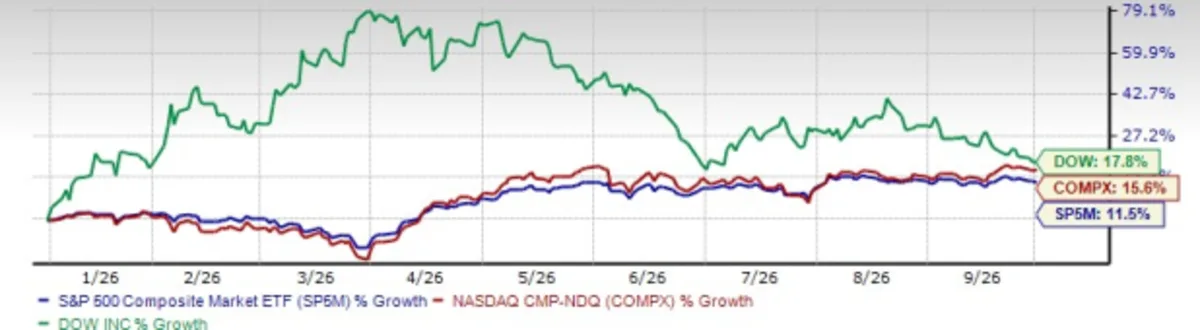
As Wall Street enters the final quarter of 2026, it has seen substantial gains despite challenges such as rising Treasury yields, persistent inflation, and declining market breadth. The S&P 500 has advanced 11.5% in the first nine months, while the Nasdaq Composite increased by 15.6%, largely driven by optimism around artificial intelligence (AI). The Dow Jones also posted a modest gain of 17.8% during this timeframe. In September, underlying vulnerabilities were revealed, with the Russell 2000 falling approximately 5%, primarily due to pressures on small-cap stocks from increased Treasury yields and concerns regarding borrowing costs.
Read More
Historically, October is known for its volatility, marked by major market crashes in 1929, 1987, and 2008. However, MarketWatch data shows the S&P 500 has averaged a 0.5% gain in October since 1928, with positive returns recorded 58% of the time. Additionally, data from Dow Jones indicates that midterm-election years since 1950 have yielded an average gain of 3% in October.
The outlook for the fourth quarter remains bolstered by strong corporate fundamentals, with FactSet projecting a 29.5% year-over-year earnings growth for the S&P 500 in the third quarter and 27.6% for the fourth. Nonetheless, monetary policy continues to present challenges. The Federal Reserve raised interest rates to a range of 3.75%-4% in September and is aiming for a projected 3.7% PCE inflation for 2026. The Congressional Budget Office has estimated the fiscal 2026 deficit at approximately $2 trillion, amplifying concerns over Treasury financing costs. These issues were underscored on October 8, when the S&P 500 dropped 0.5% due to oil price fluctuations and high bond yields.
Given these conditions, investors are advised to prioritize opportunities that are backed by robust earnings rather than engaging in indiscriminate risk-taking, as continued gains rely increasingly on corporate execution and stabilized financing costs.
In terms of sector selection, those demonstrating clear earnings growth and solid balance sheets should be favored. Key sectors include technology infrastructure, semiconductors, utilities, and select energy companies. Within technology, it is essential to identify companies that are effectively translating AI investments into revenues, earnings, and cash flow, as opposed to those that primarily depend on future growth expectations. The utilities sector may benefit from increasing electricity demands driven by data centers, although capital-intensive projects and higher financing costs pose risks. Energy companies that maintain disciplined capital expenditures and generate strong cash flow may also prove resilient amid ongoing oil price volatility.