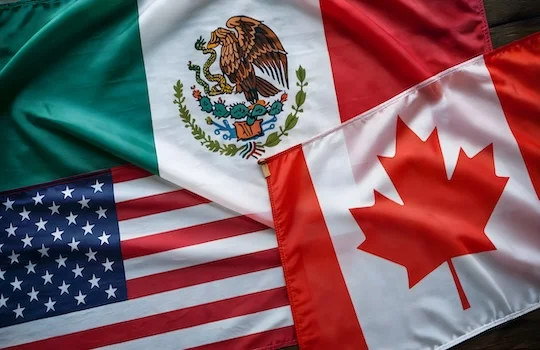
The future of the United States-Mexico-Canada Agreement (USMCA) faces increasing uncertainty as the United States, Canada, and Mexico navigate tariffs, changing trade policies, and intensified competition with China. Four trade and economic policy experts shared insights on these challenges during a webinar hosted by the Baker Institute for Public Policy at Rice University, emphasizing the priorities of each country, the effects of tariffs on interconnected industries, and the countries' ability to maintain global competitiveness.
Read More
For Luis Lozano, president and CEO of Toyota Motor de México, Mexico's foremost concern is economic stability. He noted that Mexico's ties with the U.S. extend beyond trade, encompassing border security, immigration, and narcotics, complicating negotiations over the USMCA. Lozano stressed that Mexico is grappling with a weak economy and needs more certainty to foster investment and job creation, hindered by U.S. tariffs and continuous uncertainties.
Energy policy in Mexico adds another level of complexity, as it is closely linked to national sovereignty, making it a politically sensitive issue amid U.S. concerns. As the 2027 USMCA review approaches, the panelists highlighted that the central question is whether the three nations can sustain their economic integration while adapting to a rapidly evolving global economy. Lozano pointed out that while Mexico might diversify its trade relationships, the U.S. remains an irreplaceable economic partner.
Meredith Lilly, a nonresident scholar at the Baker Institute and a Carleton University professor, outlined Canada's challenges. She reported that discussions between Canadian and U.S. officials on concessions regarding liquor, procurement, dairy, and retaliatory tariffs have stalled. Lilly noted that public resistance in Canada to U.S. pressure complicates the government's ability to re-engage in negotiations without a strong impetus, despite potential changes in economic pressures that could impact support for these negotiations.
Lilly also highlighted Canada's desire for greater trade diversification, particularly with Europe and other markets, looking at opportunities in energy, defense, and critical minerals to lessen dependence on the U.S. However, she cautioned that Canada's geographic proximity and extensive trade with the U.S. make it impossible to fully substitute this relationship.
Simon Lester, a nonresident fellow at the Baker Institute specializing in international trade law, discussed the increasing use of U.S. tariffs under the guise of national security. He raised concerns about the implications for the USMCA if the U.S. can impose tariffs while claiming national security concerns, questioning the agreement's protective nature. Despite these issues, he maintained that the USMCA retains practical significance, particularly for goods that meet its criteria, which may become more relevant under future U.S. administrations.
Steve Verheul, a former Canadian trade official involved in USMCA negotiations, stressed the importance of the region's integrated manufacturing system, using the auto industry as a critical example. The cross-border nature of vehicle and parts production means tariffs on one country can have widespread effects throughout North America. He cautioned that efforts to relocate production back to the U.S. via tariffs could diminish competitiveness within the region's supply chains.
The panelists identified China as a significant strategic challenge for North America, though they differed in their responses. Lilly and Verheul advocated for deeper integration among the U.S., Canada, and Mexico as a means of competing with China. Conversely, Lester observed that the current U.S. trade policy appears focused on trade deficits with Canada and Mexico rather than solely on building a cohesive North American block, suggesting a desire for a stronger 'fortress U.S.' rather than a unified region.
As the discussion turned to the implications of the 2027 USMCA review, the experts reiterated the importance of preserving North American economic integration. Lilly noted that Canada's resolve to resist U.S. pressure might wane if tariffs begin to inflict significant economic harm, while Verheul argued that U.S. interests align with maintaining a strong regional market to avoid disadvantaging American companies and consumers. Lozano underscored North America's strategic importance to the U.S., and Lester highlighted the relevance of upcoming U.S. elections on trade policy. The future of the USMCA hinges on whether the three nations can maintain their economic cohesiveness while adapting to a shifting global landscape.
The Baker Institute's Claudio X. González Center for the United States and Mexico aims to foster the U.S.-Mexico relationship through research, actionable policy solutions, and high-level discussions that connect ideas with practice, focusing on various crucial areas, including trade and economic integration.