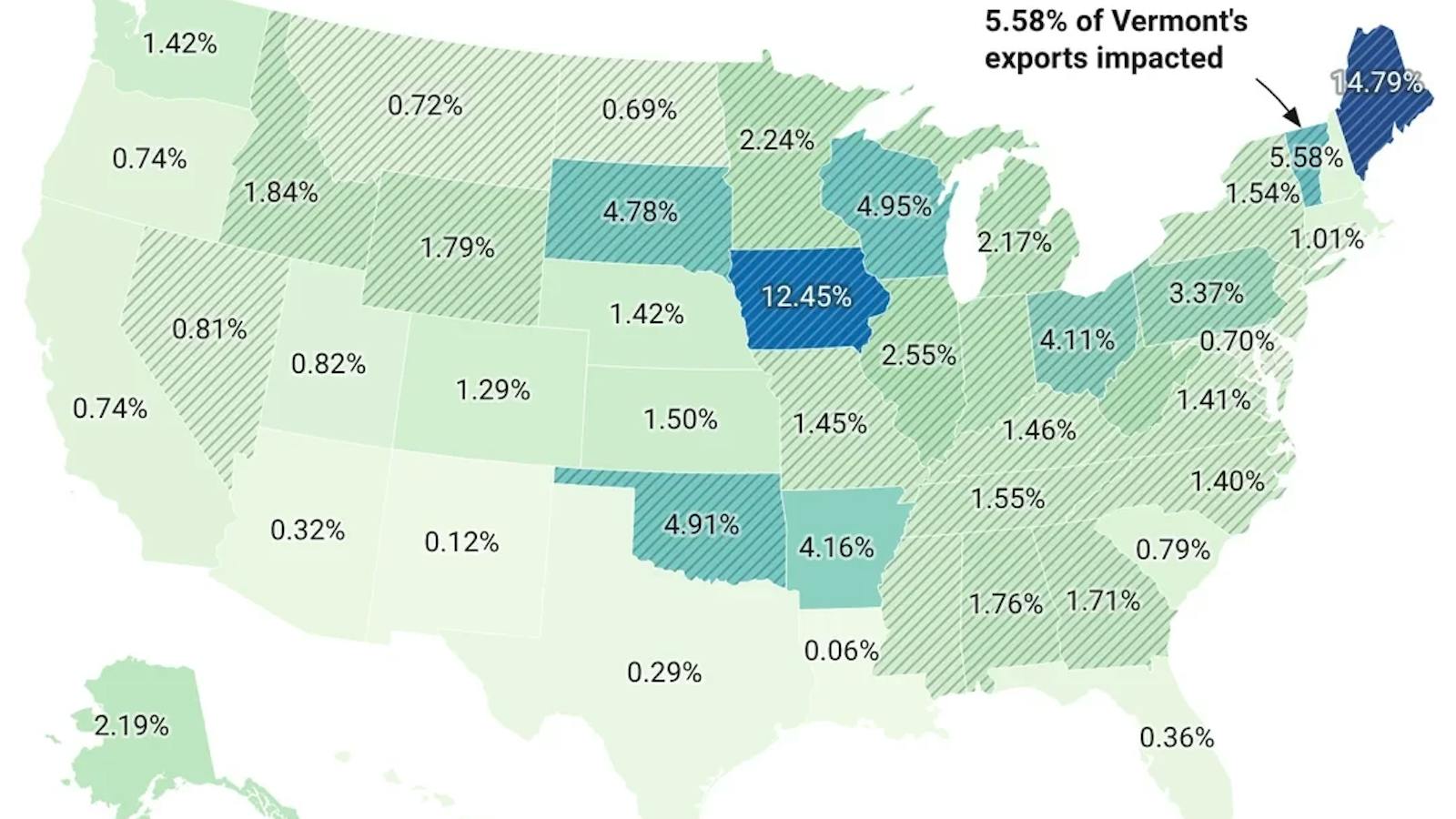
On August 22, the Trump administration announced a 50% tariff on $20 billion worth of Canadian goods, triggering retaliatory measures from Canada and placing Vermont at the center of escalating trade tensions between the U.S. and Canada. Due to its geographical proximity, Vermont's economy has historically been integrated with Canadian supply chains, particularly following the NAFTA and USMCA agreements, which facilitated cross-border trade. This disruption poses significant challenges for Vermont businesses.
Read More
In response to the tariff announcement on September 1, Vermont Senator Peter Welch convened a press conference at Jay Peak, where he engaged local business leaders about the anticipated economic fallout. He cautioned that the tariffs would have severe consequences for both Vermont and Canadian businesses, urging the Trump administration to acknowledge the unique challenges faced by border states.
Thousands of Vermont enterprises depend on Canadian partnerships, ranging from dairy farmers exporting products to custom ski manufacturers utilizing Canadian production facilities. The new customs fees threaten these long-standing relationships, pushing businesses back to the negotiating table. Tim Tierney, director of business recruitment and international trade at the Vermont Department of Economic Development, stated the importance of Canada to Vermont's economy.
Tierney's office is actively surveying businesses to assess the tariffs' impact, forecasting that the full effect will take about two months to materialize. Season Wei, an intern at the department, noted that analyzing historical tariffs allowed them to understand how current customs regulations affect local enterprises. Wei emphasized that the tariffs transitioned from being a national issue to a practical challenge faced by individual businesses.
Many products that are manufactured in part in Canada are now subject to increased costs due to tariffs. Tierney highlighted the significant impact, stating, “A $1 million engine now has a $500,000 tariff on it. That’s a major problem.” Addison County, which relies heavily on tourism and agriculture, is particularly vulnerable; in 2024, the county exported $37 million worth of goods to Canada, its largest trading partner.
By the next year, Canadian liquor boards began removing American brands from their shelves, leading to a roughly 60% drop in Canadian tourism, which historically contributed to the economy during the fall foliage season. Phil Summers, executive director of the Addison County Chamber of Commerce, warned that local businesses heavily dependent on tourism, especially in Vergennes and Bristol, would feel the strain.
To address declining tourism, various Vermont organizations have launched initiatives, such as the “State of Inspiration” tourism campaign that started on July 30. Austin Davis of the Lake Champlain Chamber has been in discussions with his Canadian counterparts to foster improved economic relations. However, recent trade talks have not yielded success, primarily due to Canada’s refusal to reconsider its French language protections, particularly ahead of the Quebec provincial elections.
The trade discord also encompasses national security considerations, since several defense firms operate across the border, meaning tariffs could affect national defense-related products as well. Davis remarked that relations with Canada, a crucial defense partner, are in a precarious position.
The likelihood of improving the Vermont-Canada trade relationship remains slim. On September 17, Canadian Prime Minister Mark Carney accepted an offer from the European Union to initiate the process of becoming an associate state, which could reshape Canada’s trade dynamics. Tierney cautioned that once supply chains shift, rebuilding them might prove increasingly difficult.
The unpredictability of federal trade policy has caused notable concern for businesses on both sides of the border. Customs brokers are assisting businesses with compliance, while many are resorting to bonded warehouses to preserve cash flow, incurring tariffs only once their inventory is accessed. Summers remained optimistic, suggesting that successful enterprises would adapt to these challenges, although he acknowledged that some smaller businesses may struggle without adequate resources.