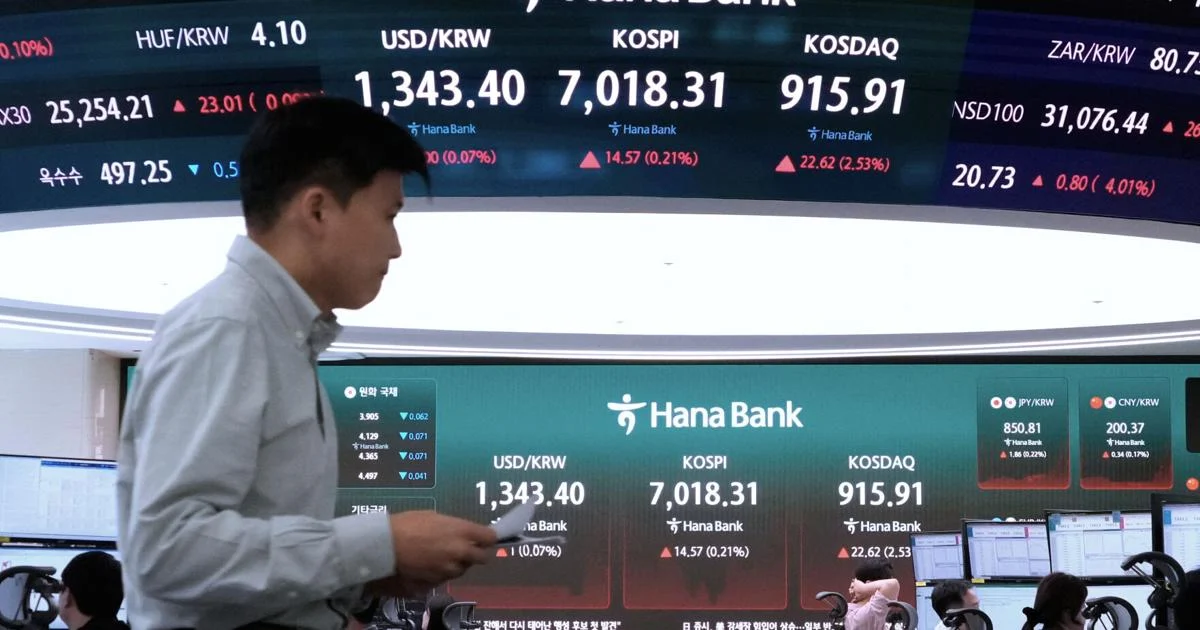
Asian stocks mostly declined on Wednesday, reversing gains from Wall Street's record highs driven by strong corporate earnings forecasts. U.S. futures showed little change, while oil prices increased.
Read More
In Tokyo, the Nikkei 225 fell 0.9% to 70,284.81. South Korea's Kospi also dropped by 0.9% to 6,876.76. Hong Kong's Hang Seng Index decreased by 0.6%, closing at 24,129.96, and Taiwan's Taiex edged down 0.2%. Markets in Shanghai were closed for a national holiday. Meanwhile, Australia’s S&P/ASX 200 inched up by 0.1% to 8,740.10.
On Tuesday, U.S. stocks reached their highest levels, with the S&P 500 climbing 0.6% to a new record of 7,818.93. This marked a 23% increase since the index's lowest point in late March, despite ongoing concerns about the Iran conflict, inflation, and pressures in the bond market. The Dow Jones Industrial Average increased by 0.5% to 51,521.28, and the Nasdaq composite rose 0.4%, closing at 27,599.79.
Ng Jing Wen of Mizuho Bank noted that the rally was indicative of investor confidence in the ability of corporate earnings, especially in technology and AI sectors, to cope with higher energy costs and interest rates. Despite rising fears about inflation, strong earnings momentum continues to drive market confidence.
Record stock prices have improved investor sentiment, although many Americans remain anxious about the increasing cost of living. Concerns that contributed to the U.S. market's decline in March, such as high oil prices related to the Iran war and increasing bond yields, have largely materialized, leading to a general sense of economic pessimism.
Strong corporate earnings reports are providing stability. Notably, Lamb Weston announced better-than-expected profits and revenue, resulting in a 7.5% rise in its stock. Many analysts anticipate robust profit reports for the July to September quarter, including Delta Air Lines, which will report on Friday, followed by major banks next week.
Analysts expect S&P 500 companies to achieve nearly 30% growth in earnings per share compared to last year. If they do not meet these expectations, stock prices may retreat from current highs. Some have raised concerns about a potential bubble in AI stocks, which have seen significant gains, including a 28.3% rise for Nvidia this year.
In the bond market, yields decreased slightly, with the yield on the 10-year Treasury dropping to 5.28% from 5.31% on Monday. This followed a period of stabilization in oil prices. Early Wednesday, crude oil prices were up 0.9%, with Brent crude at $101.49 per barrel and U.S. benchmark crude also rising 0.9% to $90.21 per barrel.
Additionally, the U.S. dollar strengthened to 158.44 Japanese yen from 158.10 yen, while the euro slipped to $1.1238 from $1.1260.
This report was contributed to by AP Business Writer Stan Choe in New York.