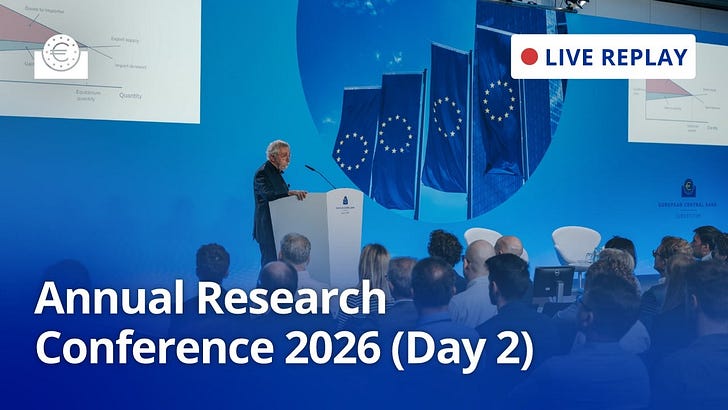
The second day of the ECB Annual Research Conference featured a session on geoeconomics led by economist Paul Krugman. The session commenced at 10:00 AM and lasted approximately 90 minutes.
Read More
Paul Krugman opened by reflecting on his decision to study international economics 50 years ago, noting that it was suggested to him that international trade was uninteresting, yet he found it intellectually stimulating. He emphasized the significance of the conference theme, highlighting the emergence of new evaluation methods and data sources in the field. Krugman remarked that challenging circumstances often lead to productive economic discussions, indicating a surge in research amid current global challenges.
The talk was structured into two main parts. Initially, Krugman shared his perspective on the current state of geoeconomics, followed by a discussion on the critical issues of economic size and power, pointing out that these discussions were well-received the previous day.
Krugman drew a parallel between the concept of weaponized interdependence in trade and elements from the science fiction novel *Dune*, illustrating the idea with a quote about control over resources: "He who can destroy a thing, controls the thing." He noted how trade dynamics can serve as a tool for coercion, referencing another quote from economist Albert Hirschman about the implications of trade cessation.
He explained that despite the existence of theoretical models that frame international economics, in practice, analyses often revert to simplified supply and demand scenarios. Krugman expressed concern about the tendency of policymakers to overlook the significant power dynamics that arise from interdependence in trade.
Krugman illustrated the dangers of this interdependence with the example of Canada and the U.S. energy trade, suggesting that perceptions of dependency often skew across political narratives. He suggested that the Elasticity of demand for imports is typically lower than the elasticity of supply for exports, which could lead to misconceptions about economic power.
The discussion covered the relative sizes and capacities of nations within the global market, with Krugman noting that all economies have some competitive advantage due to their unique products or services.
He addressed current geopolitical tensions and urged consideration of the broader implications of trade interdependence in international relations. Krugman concluded that understanding these dynamics necessitates input from both economists and political scientists to gauge the impacts of trade disruptions.
Following the lecture, Philip Lane, a member of the ECB Executive Board, thanked Krugman and invited questions from the audience, promising an engaging discussion on the topics raised.