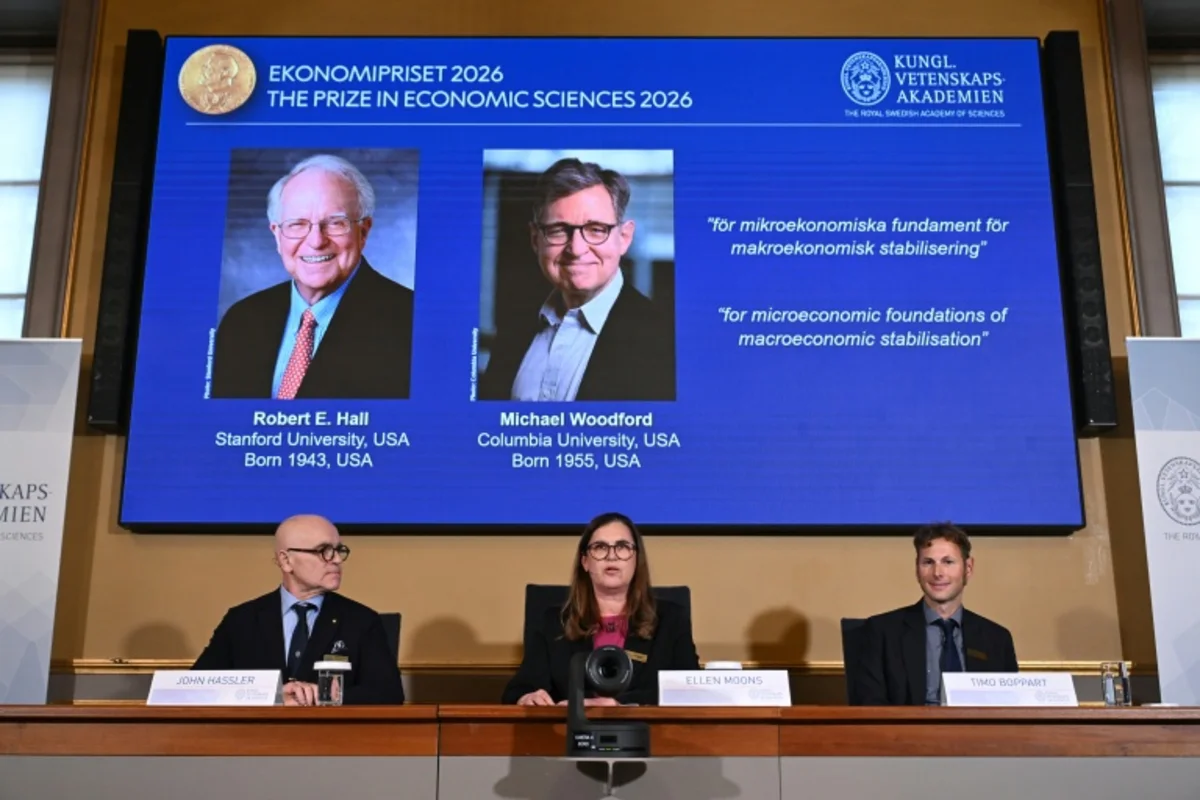
On Monday, Robert Hall and Michael Woodford, both American economists, were awarded the Nobel Prize in Economics for their contributions to understanding how monetary and fiscal policies can stabilize economic fluctuations. The Royal Swedish Academy of Sciences recognized their development of innovative models designed to manage recessions and crises that traditional economic tools fail to address.
Read More
The academy stated that Hall and Woodford's models illustrate that well-timed fiscal and monetary measures can help mitigate the extremes of economic cycles. Since John Maynard Keynes established his economic theories nearly a century ago, stabilization policies have enabled officials to boost economic growth when necessary. However, during the oil shocks of the 1970s, existing Keynesian models became inadequate.
Unlike previous approaches that relied on statistical relationships among macroeconomic factors like inflation and consumption, Hall and Woodford built models on microeconomic foundations. These models account for how individual households and businesses influence the economy through their decisions, which are often forward-looking.
Hall, now 83 and a professor at Stanford University, published a landmark article on consumption in 1978, a key moment that propelled modern consumption research. Woodford, born in 1955 and a professor at Columbia University, released a pivotal book in 2003 presenting a New Keynesian macro model based on microfoundations. According to John Hassler, chair of the prize-awarding committee, their work has provided a stable theoretical basis for the models currently used by central banks and governments worldwide.
Following the announcement, Woodford described receiving the prize as "staggering" and humorously commented about the examinations he was preparing for his students. He reflected on how traditional monetary policy tools proved inadequate during the 2008 financial crisis, when many countries had already lowered interest rates to zero. This led to new strategies from central banks, including clearer communication regarding future interest rates, a practice that continues today.
Woodford asserted that while these modern approaches did not solve economic problems outright, they significantly contributed to better stabilization. The Nobel Prize is particularly relevant now as the U.S. Federal Reserve, recently under pressure from President Donald Trump to lower rates, has updated its communication strategies regarding monetary policy.
The economics prize, although not among the original five Nobel awards established by Alfred Nobel in 1896, was created through a donation from Sweden's central bank in 1968 and is awarded using the same selection process as other Nobel prizes. The accolade includes a diploma, a gold medal, and a monetary award of $1.2 million.