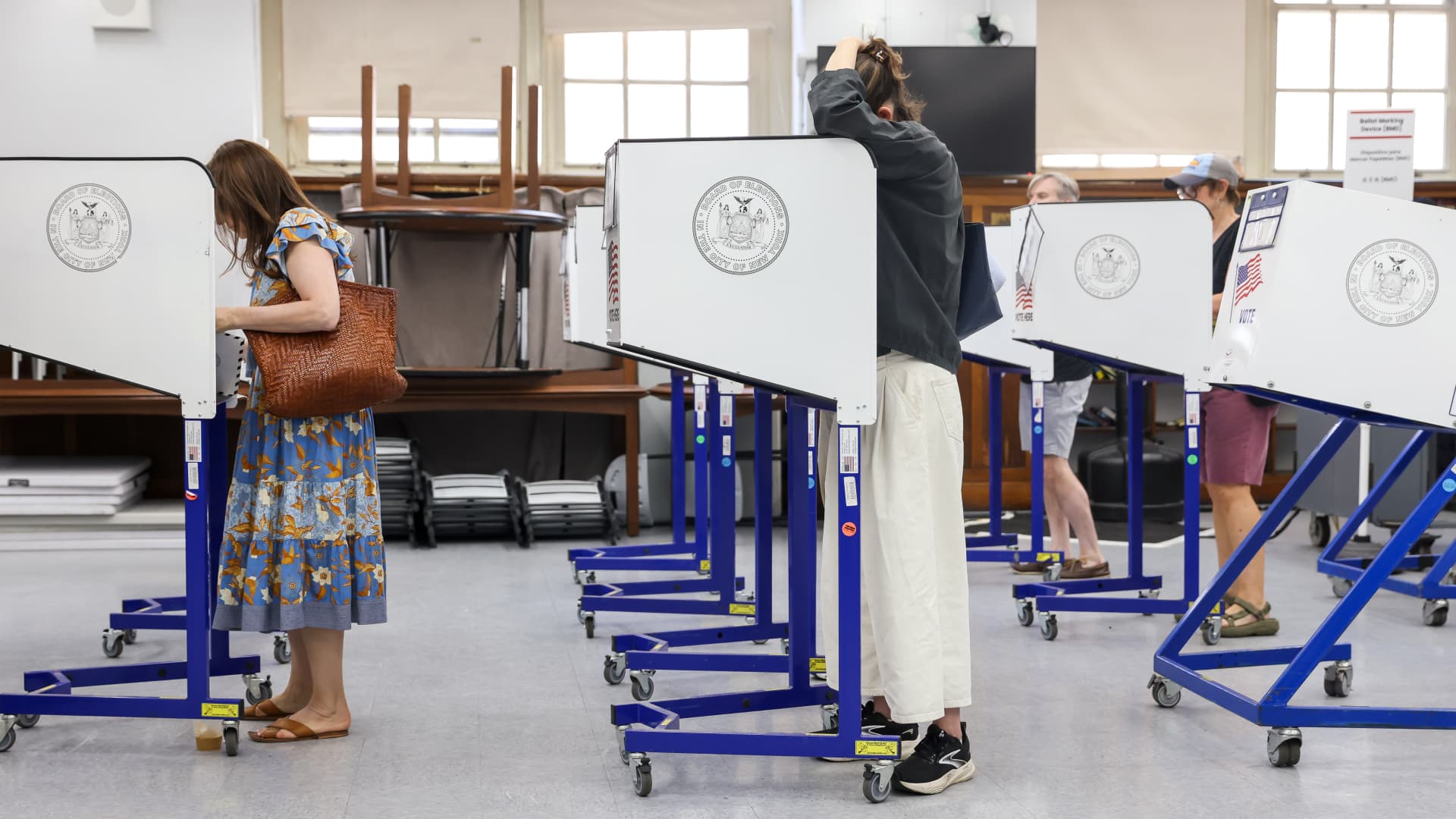
As of October 9, various polls and prediction markets indicate the potential for a "blue wave" in the upcoming midterm elections, which could lead to Democrats gaining a majority in the House and possibly securing control or a tie in the Senate. As a result, some investors are adjusting their portfolios to these possibilities, while others may be banking on Republican successes. Market analysts suggest that the political landscape, including which party governs Congress or holds the presidency, can significantly influence the stock market. However, Ryan Detrick, chief market strategist at Carson Group, argues that these assumptions are largely unfounded. He states, "It's not about red, not about blue; it's about green," emphasizing that regardless of party affiliation, the fundamental factors such as economic performance, corporate earnings, Federal Reserve policy, and inflation are far more impactful on market dynamics.
Read More
Historically, midterm years have proven to be volatile for stocks. According to research from Invesco, the U.S. stock market has generally trended upwards over extended periods, with exceptions like President Richard Nixon, who resigned midterm, and George W. Bush, whose second term concluded amidst the global financial crisis. Despite this upward trend, Detrick highlights that midterm years have the highest levels of volatility compared to other election periods, noting that the average market pullbacks are larger during these years. Interestingly, the market typically sees significant rebounds in the 12 months after such downturns. Detrick advises against trying to time a market dip during midterms for stock purchases and recommends maintaining a diversified investment strategy and allowing compound interest to work over time.
While it is understandable that investors think election results could sway the stock market, Detrick points out that, in practice, the market often operates independently of political events. For instance, while the election of Barack Obama was anticipated to favor environmental sectors, the Invesco WilderHill Clean Energy ETF dropped nearly 58% from January 2009 until the end of his term, even as the S&P 500 gained around 140%. Similarly, President Trump's election was expected to benefit coal stocks, which did not materialize; the VanEck Vectors Coal ETF fell approximately 37% over his first term while the S&P 500 increased around 46%.
Historically, stock performance has indeed been stronger under Democratic presidents, averaging roughly 12% returns compared to about 8% under Republican presidents, according to Detrick's analysis. Nonetheless, Congress controlled by Republicans has traditionally outperformed Democrat-led legislatures. Interestingly, a split Congress—where one party holds the House and the other controls the Senate—tends to yield better returns for stocks, as per historical data. Detrick suggests that this could be due to partisan gridlock, as a unified Congress often leads to increased spending, which can inflate national debt and negatively impact the stock market by pushing up interest rates. Thus, he notes, "The joke is 'the best Washington is one that can't get anything done.'" While voters may favor a cohesive Congress that promptly enacts legislation, the market appears to benefit from the delays that come with divided governance.