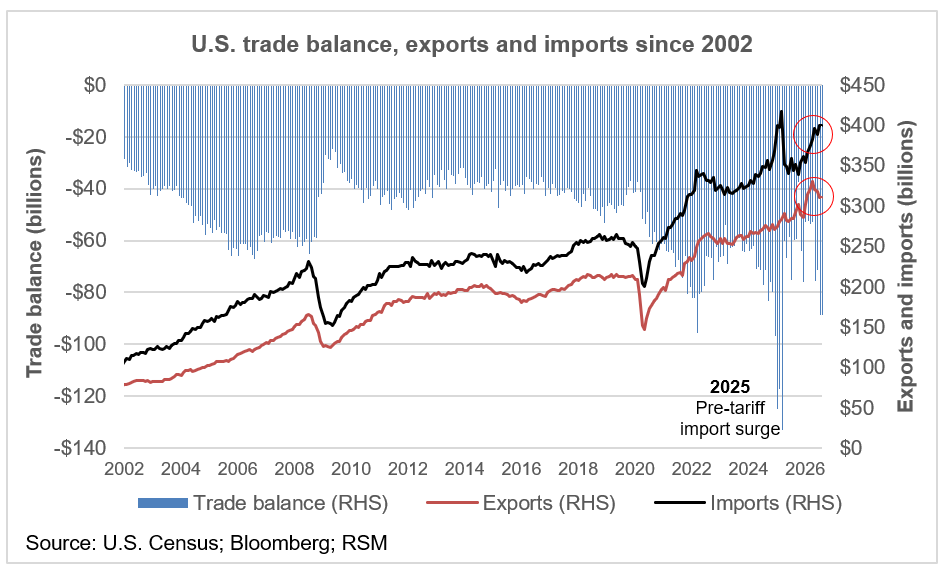
As the U.S. trade war enters its second year, data indicates that exports and imports are showing signs of weariness among trading partners. This situation is contributing to a widening trade deficit for the United States.
Read More
Current strategies aimed at rebalancing global trade in favor of the U.S. appear to be failing, with the trade deficit expanding and tariffs imposed on U.S. companies leading to increased prices for consumers and higher inflation. Imports have risen sharply while exports have been declining since reaching their peak in April 2025.
Upcoming trade data for August, set to be released on Tuesday, is anticipated to reveal that the trade deficit may exceed $100 billion for the first time since the surge before tariffs were introduced. This worsening deficit is expected to impact gross domestic product (GDP), yet growth is still projected to be 3.5% on an annualized basis for the third quarter.
Since the initiation of tariffs in April 2025, many of the U.S.'s trading partners have begun seeking alternatives, expanding their client bases while the U.S. shifts its focus inward. In particular, the agricultural sector is suffering, leading to downturns in rural economies. Proposed bans on diesel exports could exacerbate the situation by ultimately resulting in higher prices, despite any temporary relief.
The U.S. is no longer viewed as the default global market for goods, as major trading economies seek more stable partners. This shift is evident in Canada's trade strategy, as Prime Minister Mark Carney indicated that Canada intends to expand its free-trade zone and strengthen ties with the European Union. Carney has pointed out the tangible effects of the U.S. trade war, highlighting that the share of Canadian exports to the U.S. has decreased from 75% to 62% since April 2025.
The potential fracturing of U.S.-Canada trade ties raises concerns about manufacturing jobs in both countries. Notably, American-made components constitute about 50% of Canadian-produced vehicles, and Canada is the largest market for U.S. automotive exports. Additionally, Canada supplies 70% of the potash vital to American farmers. Disruptions to these ties could lead to increased shipping costs and higher grocery prices in the U.S.
U.S. trade data reveals a consistent decline in goods exports since April 2026, while service exports have plateaued. Although the U.S. is a net exporter of petroleum, which reached $26 billion and accounts for 8.5% of total exports, this figure may decline as energy prices stabilize.
Imports have surged to levels previously seen before the 2025 tariff implementation. Recent increases suggest that importers are preparing for continued unimpeded shipping. Among various import categories, only capital goods have shown growth compared to prior years.
In the capital goods category, imports related to tech—such as telecommunications equipment, semiconductors, and computers—now make up a substantial portion of recent imports. This trend highlights a contradiction in policy, considering that promoting artificial intelligence and productivity may require a steady flow of necessary goods.
In summary, the current trade restrictions are negatively affecting both exporters and importers, leading to heightened costs for businesses and households. The notable exception is the ongoing growth in imports of capital goods, driven by investments aimed at enhancing productivity and accelerating advancements in artificial intelligence.