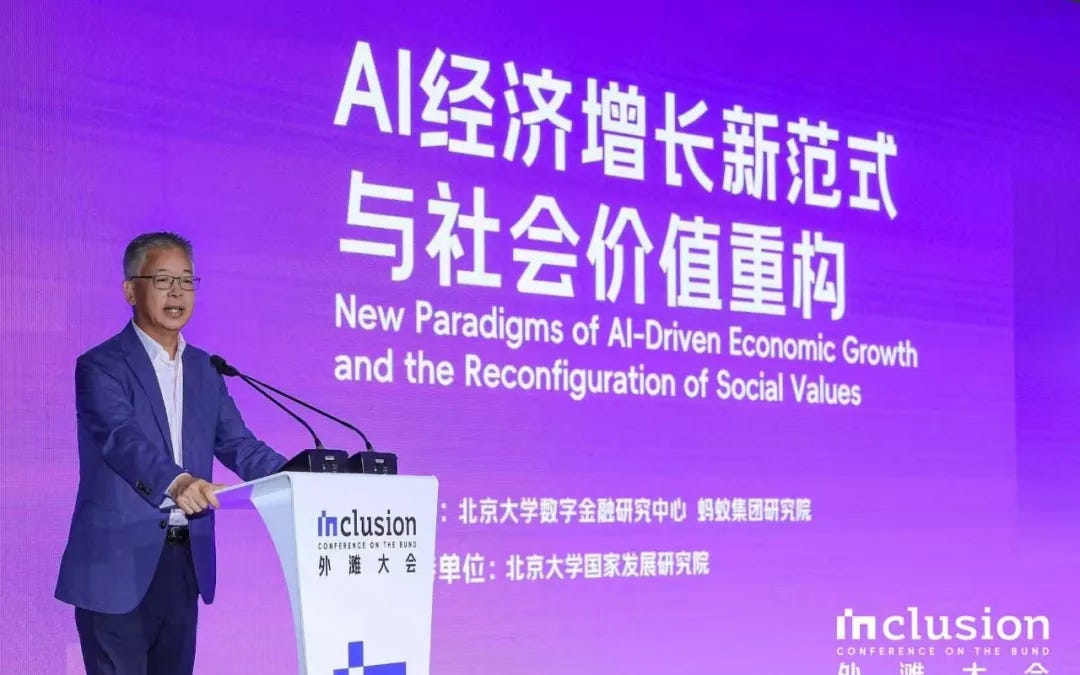
Huang Yiping, a distinguished professor and dean at Peking University's National School of Development, expressed concerns that artificial intelligence (AI) could worsen the existing imbalance between robust supply and weak demand in China's economy, while enhancing productivity. Speaking at the Inclusion Conference on the Bund in Shanghai on September 9, 2026, Huang referenced the "Solow paradox" and "Engels' pause," emphasizing that technological advancements do not automatically yield immediate productivity improvements or wage increases for workers. He advocated for an "employment-first AI innovation" approach, suggesting that persistently low demand may require more innovative public policies.
Read More
In his remarks, Huang outlined the transformative potential of AI on the economy and society, noting that Peking University had initiated an "AI + Disciplinary Innovation" research program in 2025. He highlighted that the effects of AI are felt across various economic disciplines, but its ultimate impact on productivity and employment remains largely uncertain.
Huang pointed out that historical patterns, like the Solow paradox, indicate that immediate economic benefits from technological changes can be elusive. While he remains optimistic about AI's ability to enhance productivity, he cautioned that this will not lead to instant economic growth. He posed critical questions about the future of employment in the age of AI, noting that the types of jobs at risk may evolve as technology progresses.
He underscored the importance of considering how AI could disrupt job markets and influence income distribution, noting the potential creation of a divide not only among workers but also between returns to capital and returns to labor. Huang drew parallels to historical events, referencing the "Engels' pause," a period when economic productivity increased but real wages for workers remained stagnant, suggesting that similar patterns could emerge as AI develops.
Huang argued that AI could amplify the current supply-demand imbalance in China's economy, potentially resulting in fundamental shifts in economic paradigms. He emphasized that addressing these issues would require a proactive approach in public policy, moving beyond conventional short-term solutions to tackle long-term challenges.
He concluded by calling for a responsibility-oriented approach to AI innovation, which should prioritize job creation and empower workers, rather than merely enhancing efficiency at the expense of employment.