In the second quarter of 2026, agricultural loan balances at U.S. commercial banks rose, driven by increases in both farm real estate and non-real estate loans. Delinquency rates for farm loans at agricultural banks decreased slightly compared to the previous quarter but remained similar to levels from a year earlier. Net interest margins expanded as yields on earning assets rose while funding costs stayed relatively stable.
Read More
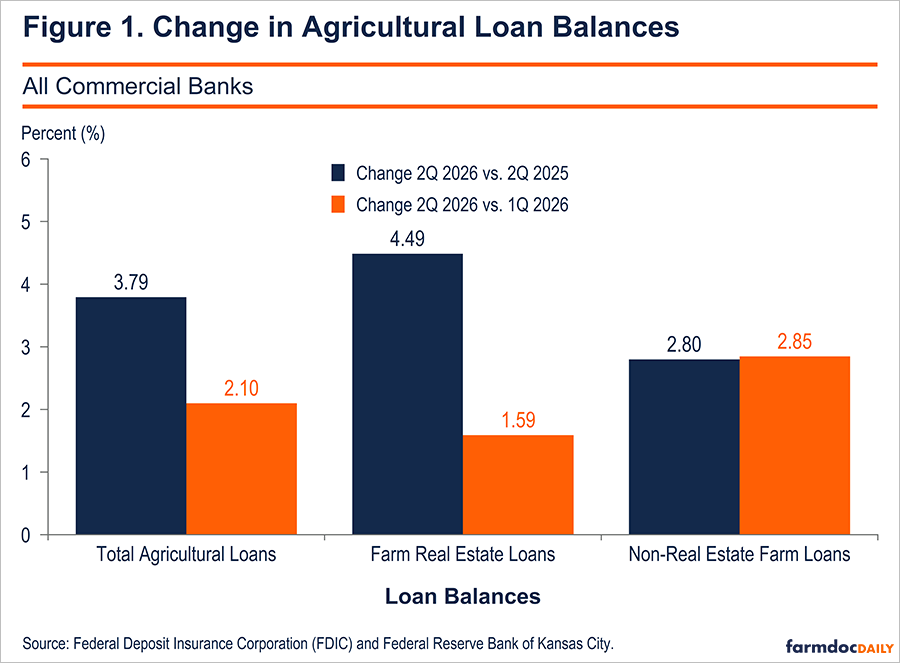
Total agricultural loans at commercial banks amounted to $206.27 billion, an increase of $4.24 billion (2.10%) from the first quarter and $7.54 billion (3.79%) compared to the same quarter in 2025. These loans include both farm real estate, secured by farmland and improvements, and non-real estate loans, which finance agricultural production and related purchases.
Outstanding farm real estate loans reached $122.26 billion, representing a 1.59% increase from the previous quarter and a 4.49% increase year-over-year. Non-real estate farm loans grew by 2.85% during the quarter and 2.80% over the year, totaling $84.00 billion.
Agricultural banks, which hold about 42% of the total farm loans among commercial banks, reported $86.92 billion in total farm loans in Q2. Their non-real estate loan balances rose by $1.55 billion (4.23%) after experiencing a decline in the first quarter. However, the annual growth rate for these loans slowed from 5.35% in Q1 to 3.68% in Q2, lower than the 7.29% growth seen in Q2 2025.
Farm real estate loans at agricultural banks also increased, growing by $2.10 billion (4.50%) to reach $48.80 billion following a decline in the prior quarter. The annual growth rate for these loans increased from 1.10% in Q1 to 2.85% in Q2.
The delinquency rates for agricultural loans at these banks showed improvements, with non-real estate farm loan delinquencies decreasing to 1.00% from 1.30% in Q1, while farm real estate delinquencies fell to 1.45% from 1.78%. However, these rates were largely unchanged compared to the previous year.
Net interest margin (NIM) for agricultural banks rose about 13 basis points to reach 3.94%. The yield on earning assets increased to 5.75%, while the cost of funding earning assets slightly increased to 1.81%. This quarter-over-quarter NIM growth was mainly attributed to higher asset yields, with the year-over-year increase driven largely by lower funding costs.
In summary, agricultural loan balances grew in Q2 2026, with farm real estate loans contributing significantly to the increase. While delinquency rates improved in the quarter, they remained close to previous year levels. Agricultural banks also benefitted from an improved net interest margin, reflecting stronger earnings and stable funding costs.