A reader inquires about the current stock market's behavior, noting that typically, when bond yields rise, the volatility index (VIX) increases as well. However, this time, the VIX is declining. The reader asks if this scenario is unusual and what it might indicate for the future.
Read More
This question reflects a fundamental principle in finance: the present value (PV) of an asset equals the future value of cash flows (FV) divided by one plus the discount rate (r) raised to the number of periods (n). As interest rates increase, the present value of assets should decrease, which aligns with mathematical theory.
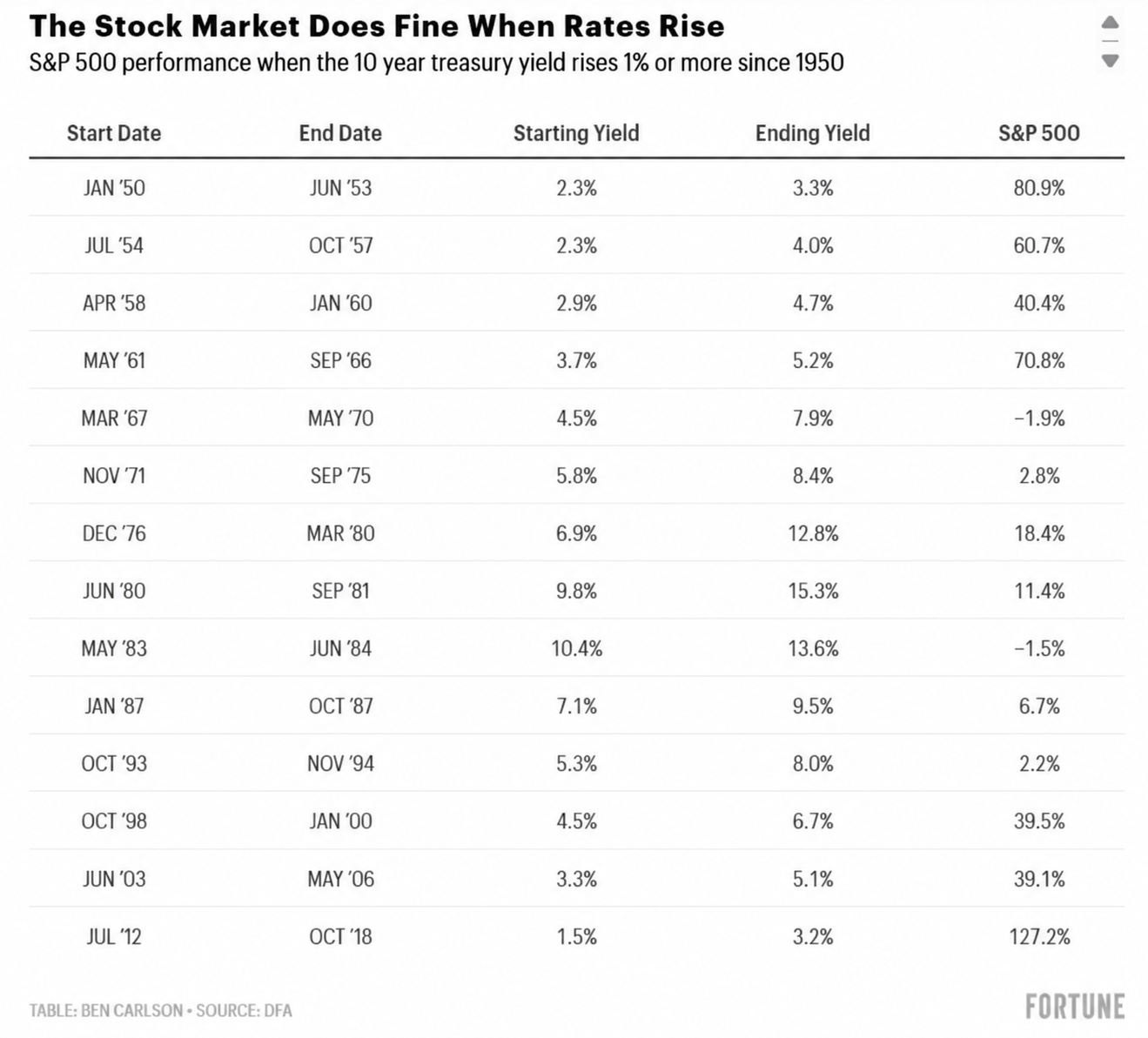
Despite this, the stock market has shown resilience this year, rising by double digits while 10-year Treasury yields have surged by 30%. Historically, the stock market tends to perform adequately when interest rates rise, often seeing higher returns in such environments.
Rising interest rates are typically associated with enhanced economic growth, whereas falling rates are often a response to economic downturns. In early 2021, concerns arose regarding the implications of government pandemic spending on inflation and rates. I suggested at that time that inflation posed a more significant risk to the stock market than increasing interest rates.
Historical data supports this notion; in 12 out of 14 instances where the 10-year Treasury yield rose by 1% or more, the stock market finished positively overall, despite some volatility.
However, 2022 presented a unique situation where both inflation and rising interest rates contributed to a 25% decline in the stock market. This illustrates that there are no absolute rules governing market behavior.
Presently, inflation is lower than it was in 2022, having increased from 2.4% before the war to 3.4% in the latest report. Economic growth is currently stronger, bolstered by advancements in AI and a recovering labor market, although the conflict in Iran has led to rising energy prices and renewed inflation concerns.
Despite these challenges, the stock market remains stable, benefiting from robust earnings growth. While rising interest rates may compress valuations, they do not necessarily lead to falling prices. Context is crucial, as stock performance cannot be evaluated solely through the lens of interest rates.
If profits continue on an upward trend, significant market sell-offs seem unwarranted. That said, higher rates may prompt some investors to shift funds from stocks to fixed income, particularly with bond yields of 5-7%. Such changes could induce equity volatility.
Excessive inflation would also raise alarms for the stock market. A prior discussion emphasized that moderate inflation can be beneficial, but excessive inflation could create significant issues.
Determining the specific interest rate level at which stock volatility could ensue remains uncertain. This topic was further explored in a new episode of Ask the Compound, where Jonathan Novy addressed questions concerning life insurance, long-term care insurance, bear markets, and consumer sentiment.