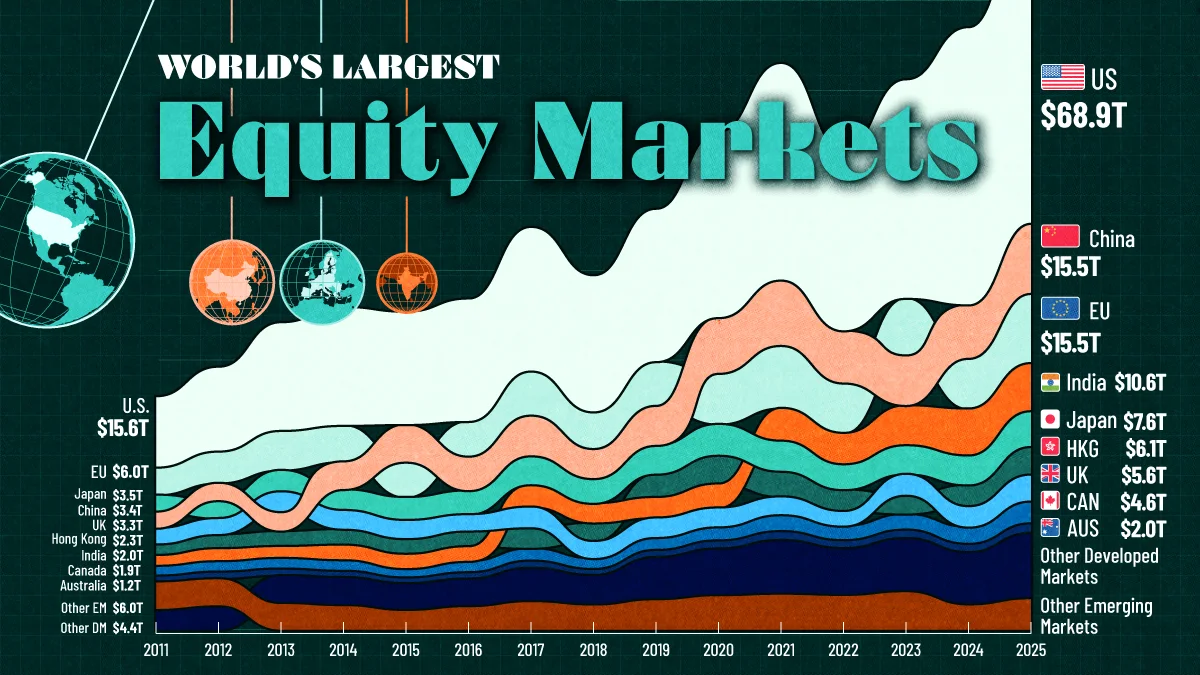
Global equity markets experienced an increase of over $100 trillion in value between 2011 and 2025. The U.S. market led this growth, with its capitalization rising from $15.6 trillion in 2011 to an estimated $68.9 trillion in 2025. By 2025, China's market had matched the European Union's at around $15.5 trillion, following its surpassing of Japan's equity market in 2014.
Read More
The last 15 years have seen a significant shift in the distribution of global equity market value, reflecting various growth rates among nations. This data, derived from World Federation of Exchanges and published in SIFMA's Capital Markets Fact Book, illustrates market capitalization based on outstanding shares at current prices, with all figures expressed in nominal U.S. dollars without inflation adjustments.
The United States expanded its share from less than a third to approximately 44% of the global total by 2025. In that period, China's equity market ascended past Japan's in 2014, and India overtook Japan in 2021. Despite continuous growth, the U.S. share of global equity decreased from about 47% in 2024 to 44% in 2025 as other markets grew more rapidly. The U.S. remains home to the New York Stock Exchange and Nasdaq, the world's two largest stock exchanges.
The substantial rise of major technology companies has contributed to the U.S. market's enhanced prominence. These firms, which include those focused on software, digital advertising, and cloud computing, have a global customer base, allowing revenues to extend beyond the U.S. market. Recently, advancements in artificial intelligence have further driven investor interest, significantly increasing valuations for certain tech companies. Anticipations of future profits often lead to rising share prices even before the actual earnings materialize, impacting the wider market.