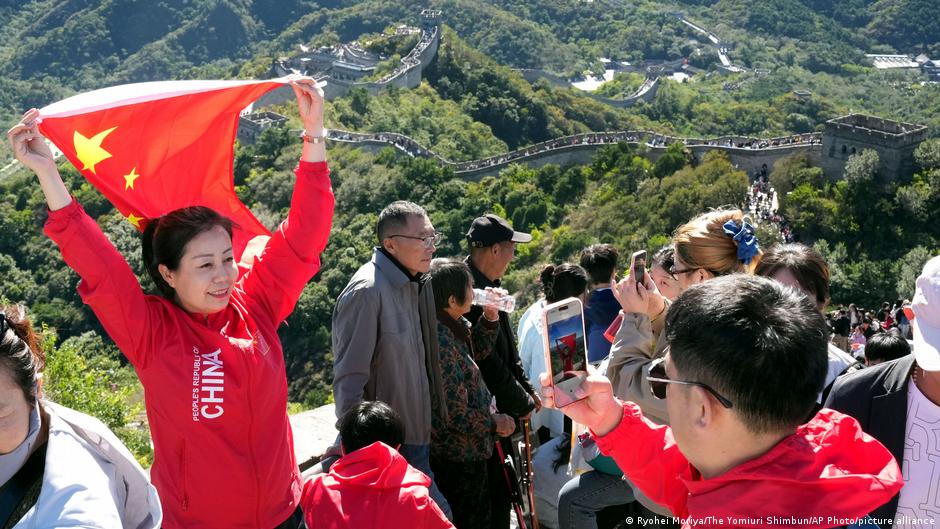
During China's Golden Week, which followed the Mid-Autumn Festival on September 25 and the National Day on October 1, 31.19 million passengers traveled, reflecting a significant movement despite cautious consumer spending. Ya Xi, a traveler returning to Shanghai, noted that she prioritizes budget-friendly options, stating, "I can stay up all night for a cheaper ticket."
Read More
Many travelers showed increased prudence regarding their spending this year. Ya Xi, in her mid-20s, confirmed, "I earn less this year, so I'm lowering my budget for this year's Golden Week," having spent 5,000 yuan (about €660) primarily on her flight.
Golden Week is often considered a gauge of economic activity in China. State media reported a record 25.204 million train passenger trips on October 1, yet initial data suggested only modest spending per traveler and flat overall passenger traffic, according to Citigroup analysts. Traffic rose just 0.1% year-over-year during the holiday's first four days, a significant slowdown compared to the 3.5% increase seen during the Labor Day holiday earlier this year.
Experts noted a trend of selective spending among younger consumers. Lizzi C. Lee from the Asia Society Policy Institute remarked that while consumers are willing to spend, they are being more cautious about their expenses. "They'll spend on travel, concerts, restaurants, experiences, and tech… if they think it's worth it, they’ll economize aggressively elsewhere," she explained.
Ya Xi's travel patterns reflected this behavior; she chose to dine generously, budgeting 200 yuan (about €26) per meal while economizing on other aspects of her trip. Guo-Chen Wang from the Chung-Hua Institution for Economic Research described the ongoing trend of budget travel, indicating that while the number of trips is increasing, overall consumption remains under pressure.
Despite government efforts to stimulate spending by issuing coupons worth over 310 million yuan (€41.2 million), Wang expressed doubts about their effectiveness, labeling it an outdated approach to a persistent issue. Historical data reveals that last year, the average spending per trip during Golden Week dropped to 911.04 yuan (around €121), the lowest in three years.
Analysts attribute the week’s weak consumer demand to deeper economic problems. Wang stated, "Beijing still believes the low spending was due to consumers' reluctance, but we think they are unable to spend," emphasizing that a substantial portion of savings is concentrated among a small segment of the population, leaving the majority without reserve funds. He highlighted the wealth gap as a critical obstacle.
The International Monetary Fund has pointed out ongoing weakness in domestic demand in China, a situation exacerbated since the property market correction began during the pandemic. Lee identified a lack of consumer confidence as central to the subdued spending observed during Golden Week, attributing it to the property downturn affecting household wealth and income expectations.
Ahead of the holiday, new travel restrictions were implemented on September 15, limiting citizens viewed as risks to national security from leaving the country. Wang anticipated a shift toward domestic travel, but this did not fully materialize, as overseas travel continued to grow, albeit slowly. Lee noted that while the new rules allow for more scrutiny of travel purposes, they do not significantly hinder outbound tourism possibilities.
This analysis illustrates the complexities of consumer behavior during a pivotal holiday period in China.