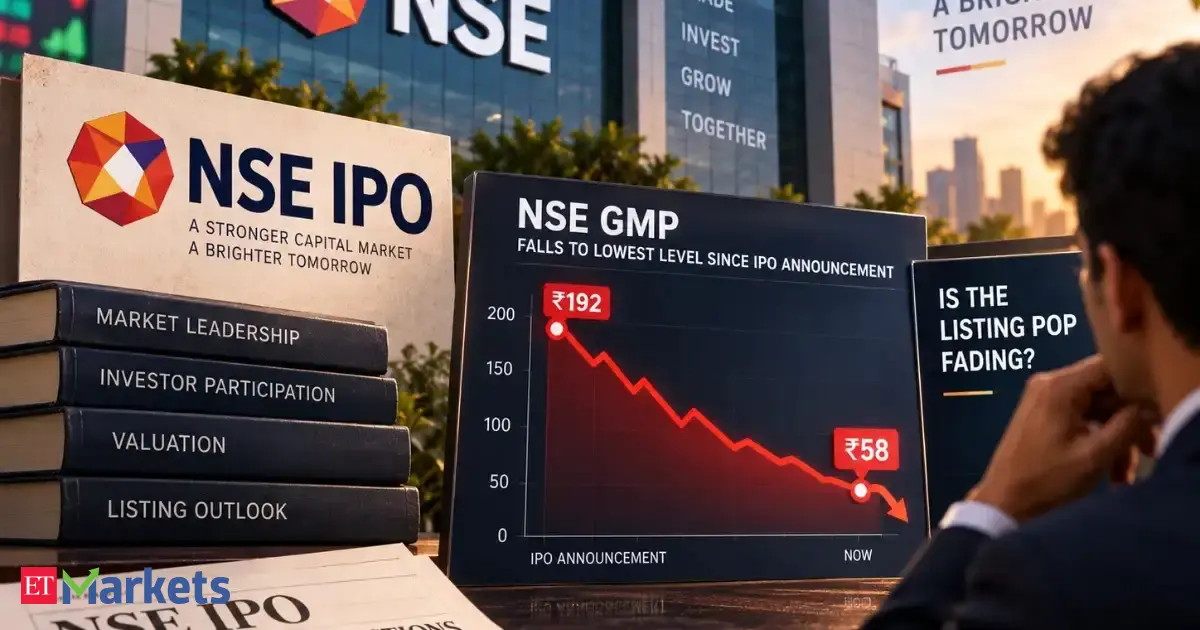
The grey market premium (GMP) for the National Stock Exchange (NSE) IPO has fallen to its lowest level since the price band was established. Initially set at approximately Rs 192, the GMP has now dropped to about Rs 58, indicating a premium of just over 3% at the upper end of the IPO price band of Rs 1,785. This represents a decline of nearly 70% in the informal market premium.
Read More
Despite this slump, the IPO, valued at Rs 22,562 crore, was fully subscribed on the second day of bidding. As of September 18, the issue was subscribed 1.15 times, with qualified institutional buyers (QIBs) leading the subscriptions. The QIB portion was subscribed 1.32 times, while non-institutional investors (NIIs) subscribed between 1.36 and 1.44 times. Retail participation, however, lagged at around 66-68%.
The IPO, which opened on September 17 and is set to close on September 21, is entirely an offer for sale (OFS), meaning the NSE will not receive any new capital from the issue. Existing shareholders are selling about 12.64 crore shares. The price band for the shares is fixed between Rs 1,700 and Rs 1,785, with a listing expected on the Bombay Stock Exchange on September 24.
The decrease in GMP suggests a cooling of listing expectations. While NSE is a key player in India’s market infrastructure, the size and fully priced nature of this IPO make it difficult to generate significant listing gains. Smaller IPOs with a compelling growth narrative are more likely to see a substantial GMP increase. Analysts note that the large size of this IPO can absorb substantial demand and limit extreme listing gains.
Analyst Avinash Gorakshakar previously indicated that the grey market sentiment suggested a favorable listing outlook, but advised investors to temper their expectations. He emphasized that the substantial size and lack of fresh growth funding could lead to more moderate upside potential compared to smaller, high-growth IPOs.
Since the IPO does not result in fresh capital being raised, it alters the way investors view the offering. Normally, a fresh issue is perceived as a pathway for growth, while an OFS focuses on price discovery and liquidity for existing shareholders. Analyst Ishan Tanna noted that NSE's pricing strategy was a practical decision intended to provide some upside to public investors without overextending the valuation.
At the upper price band, NSE is valued at about Rs 4.42 lakh crore, translating to roughly 43 times FY26 earnings, a premium compared to many global exchanges. Collectively, investors are paying for NSE’s status as a leading entity in India’s capital markets.
While the subscription figures are decent, they do not indicate a frenzied demand. The issue received 42% subscription on the first day, with retail investors initially showing more interest than institutional investors. As institutional bidders typically place larger orders towards the end of the offering, the final day of the subscription may be pivotal.
Although the IPO had achieved full subscription by the second day, retail demand remained below full subscription, raising concerns considering NSE’s anticipated appeal due to its strong brand and long-awaited listing.
At a GMP of Rs 58, the expected listing gain appears modest, with the stock likely listing around Rs 1,843 compared to the issue price of Rs 1,785, a significant decrease from earlier projections when the GMP was nearing Rs 192. Analyst Dr. Ravi Singh cautioned that while NSE is a strong business, issues like valuation and reliance on derivatives should be carefully monitored as they impact future earnings. Paresh Bhagat, Chairman of Mangal Keshav Financial Services, suggested that investors need to differentiate between the quality of the business and the valuation of the IPO.