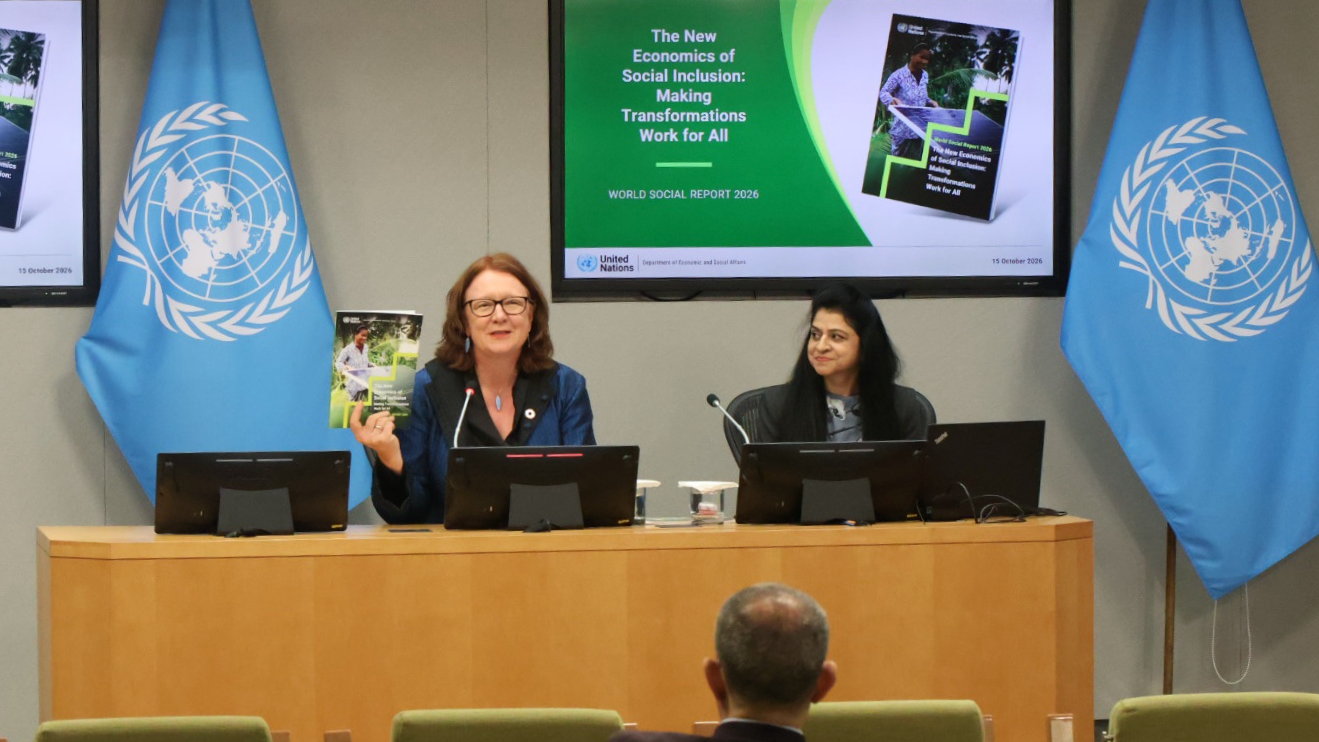
A new report by the United Nations Department of Economic and Social Affairs (UN DESA), titled The World Social Report 2026: The New Economics of Social Inclusion: Making Transformations Work for All, reveals that while economic, digital, and energy transformations are rapidly changing the global landscape, billions of people remain excluded from essential opportunities and services.
Read More
The report warns that the cost of exclusion is increasing and emphasizes that social inclusion is crucial for sustained economic resilience and equitable transformation.
Key findings from the report indicate significant disparities despite overall progress in income, education, and healthcare. In 2025, 58% of workers worldwide were employed informally, 27% of young women aged 15 to 24 were neither employed nor in education or training, and 26% of the global population lacked internet access. Moreover, over 50 countries, including 23 high-income nations, experienced rising income inequality from 2000 to 2024.
These disparities hinder productivity and resilience, making it difficult for societies to adapt to disruptions like technological change and climate challenges.
In 2025, approximately 2.2 billion people lacked internet connectivity, and those who were online often faced issues such as high costs and limited digital skills. Unless proactive measures are taken, the digital divide could exacerbate inequalities in education and economic growth.
The report also identifies the impacts of climate change, noting that of the 1.1 billion individuals living in multidimensional poverty, 887 million are vulnerable to major climate hazards. These issues primarily affect the most resource-constrained populations, threatening livelihoods and essential services.
It highlights the economic ramifications of delaying social inclusion, stating that failure to invest in social protection can lead to a potential loss of 12% of economic output over ten years compared to nations that prioritize these initiatives.
The report introduces a new metric for evaluating Socially Inclusive Transformation (SIT) across 168 countries over the past 25 years. Malta, Ireland, and Denmark received the highest SIT scores, while many African nations scored lower. Latin American countries displayed a diverse range of performance, in contrast to European nations.
Significantly, the report reveals a "conversion gap" where countries may show similar levels of transformation yet achieve different inclusion outcomes. Countries known for economic advancements, such as the USA, Singapore, and China, did not rank highly on inclusiveness indicators.
The findings underscore that economic and digital transformations do not inherently guarantee broader social inclusion and shared prosperity. National policies and governance are critical in determining who benefits from these changes.
In advocating for the New Economics of Social Inclusion, the report argues that successful transformation requires inclusive access to quality education, healthcare, connectivity, and employment opportunities.
To address these challenges, the report outlines four priorities: expanding access to education and social protection, ensuring universal digital connectivity and sustainable energy, creating equitable labor market policies, and promoting fair distribution of economic gains.
It calls for renewed international collaboration to support inclusive transformation, especially in developing countries facing financial constraints exacerbated by rising debt and geopolitical fragmentation.
The report concludes that while transformation is unavoidable, exclusion is not, and prioritizing people in these processes can create more productive economies and resilient societies.