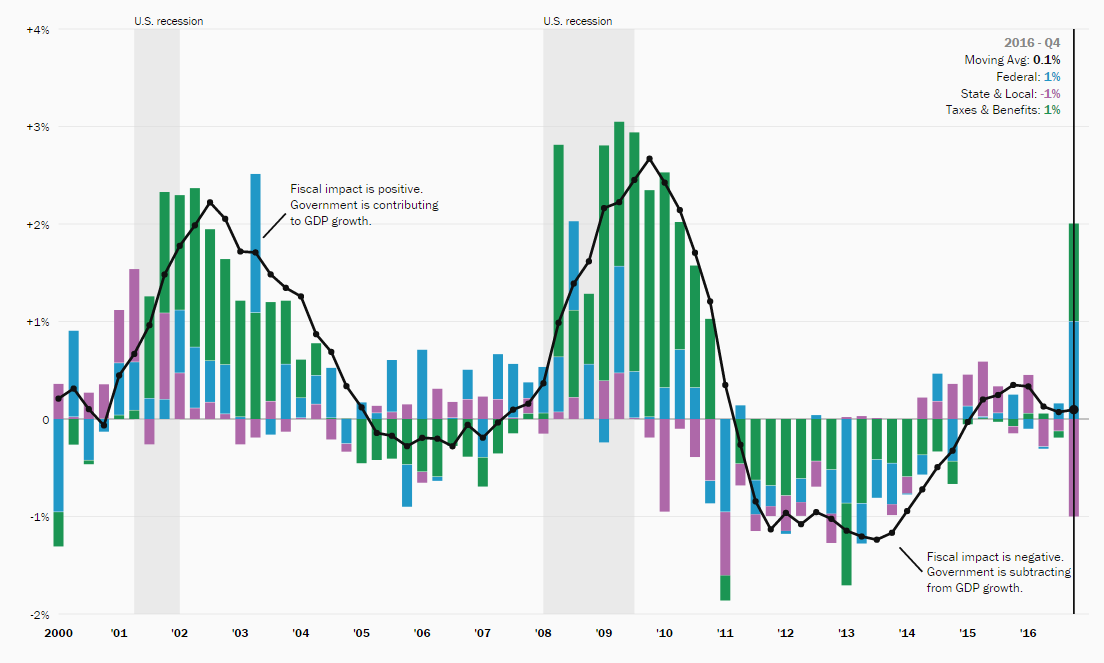
The Hutchins Center Fiscal Impact Measure (FIM) assesses the effects of local, state, and federal tax and spending policy on overall economic growth, as well as providing near-term forecasts of fiscal policies’ impacts on economic activity.
Read More
According to the FIM, fiscal policy subtracted 0.1 percentage points from U.S. GDP growth in the second quarter of 2026. Real GDP grew at an annual rate of 2.2% in that period, based on the latest government estimates. The report indicates that real federal spending reduced GDP growth by 0.3 percentage points, while combined state and local spending reductions accounted for another 0.1 percentage point. Conversely, other factors, including taxes, tax cuts related to the One Big Beautiful Bill Act (OBBBA), transfers, tariffs, and supply-side factors, increased GDP by approximately 0.3 percentage points.
Looking ahead, fiscal policy is expected to remain moderately restrictive through the end of 2026, influenced by continued weakness in government purchases and the impact of tariffs, though these effects will be partly counterbalanced by the stimulative impact of tax cuts in the OBBBA. In 2027, a more restrictive fiscal environment is projected as government purchases remain weak and supply-side effects, particularly from equipment investments linked to the CHIPS and Inflation Reduction Acts, turn negative.
The forecast relies on existing laws and does not predict any new tax or spending legislation; it also assumes that tariff rates will stabilize at levels observed in the second quarter. This positioning is based on the expectation that tariffs imposed under Sections 232, 301, and 338—related to allegations of discrimination against U.S. commerce by Canada—will largely offset revenues generated under prior tariffs.
Annual updates to the National Income and Product Accounts have increased the FIM by approximately 0.21 percentage points in 2023 and 0.09 percentage points in 2024, mainly due to stronger state and local spending.
The FIM tracks the direct effects of fiscal policy on GDP growth, considering both discretionary actions and automatic stabilizers, and incorporates estimates of supply-side impacts as well as uncertainty. For further information on the effects of fiscal policy, readers are encouraged to review the detailed analysis provided by the Brookings Institution.